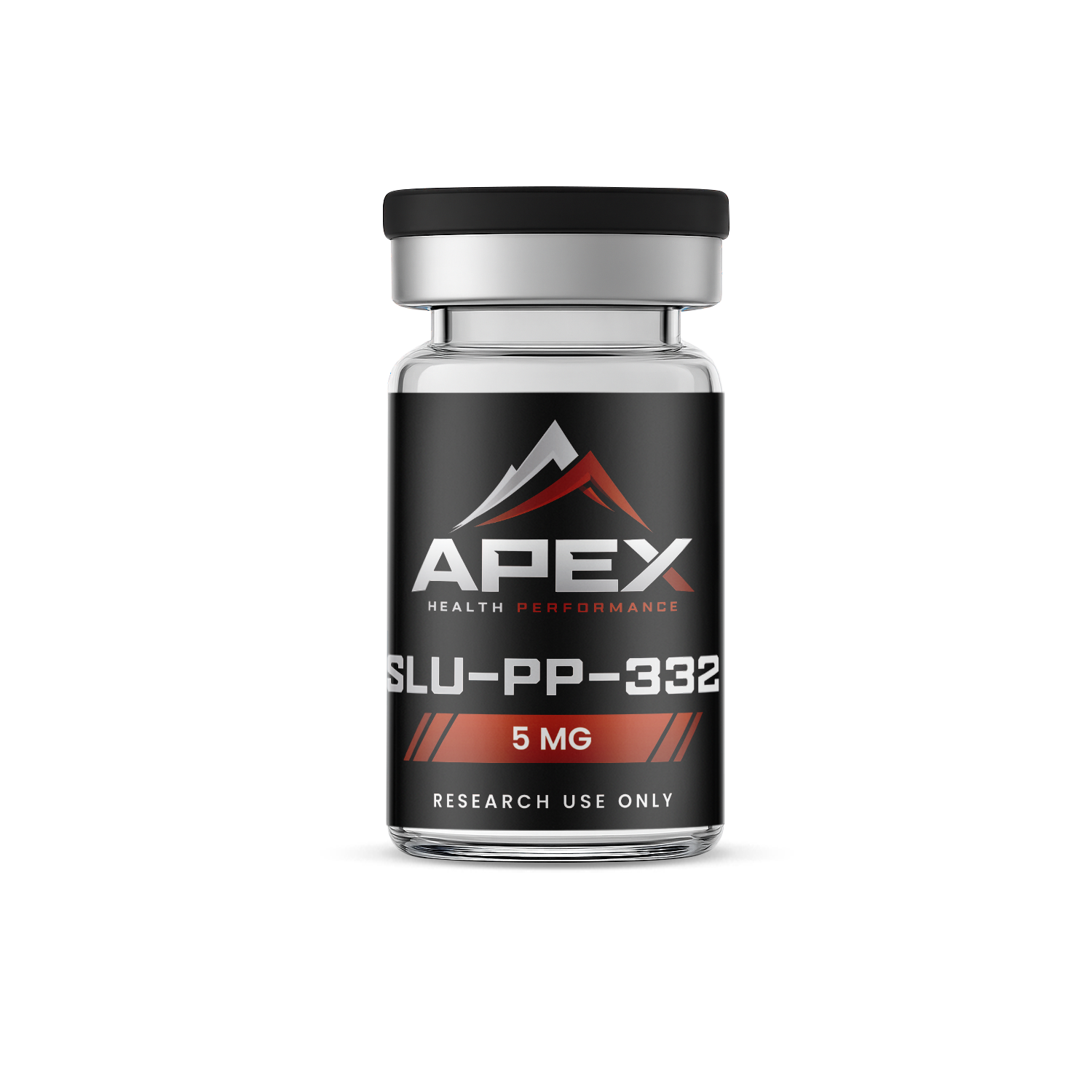
SLU-PP-332 (5mg)
$110.00
1 published certificate
Certificate information is temporarily unavailable.
Description
A single-component research material supplied for controlled research environments. Formulated for advanced studies examining metabolic regulation, mitochondrial activity, and peptide signaling pathways in model systems.
Composition
• SLU-PP-332
• Appearance: Lyophilized powder in a sealed research vial
Research Focus (non-clinical)
• Evaluation of peptide impact on PGC-1α signaling and mitochondrial biogenesis
• Studies investigating potential roles in skeletal muscle metabolism models
• Development of in-vitro and in-vivo assays for metabolic pathway mapping
• Stability and solubility testing of SLU-PP-332 under various laboratory conditions
For qualified research professionals and institutional laboratories. Not for human use.
Documentation & Quality Assurance
Each lot is sourced through our verified global supply chain with emphasis on traceability and quality control.These documents are reviewed internally and displayed as they become available.
Important Notice
This product is intended for laboratory research use only. It is not intended for human or veterinary use, and must not be used for diagnostic, therapeutic, or clinical purposes.
This material is not a drug, medical device, or dietary supplement, and has not been evaluated by the U.S. Food and Drug Administration.
Quality & Manufacturing
We work directly with the manufacturers. Each supplier is reviewed for reliability, documentation integrity, and transparency in testing.
Our minimum purity standard is 98%. Every batch we ship has its own certificate of analysis, and every certificate confirms identity, purity and net content. Where available, endotoxin testing results are included on Certificates of Analysis to verify laboratory purity; their inclusion is for research quality assessment only and does not imply suitability for human or veterinary use.
All research materials are sealed for integrity and packaged for stability during storage and transport from manufacturing through final delivery.
Additional information
| Weight | 0.0625 lbs |
|---|
Certificate of Analysis
Every batch undergoes independent third-party laboratory analysis to verify identity, potency, and safety. Testing includes quantitative assay verification, heavy metals screening, and comprehensive microbial analysis.
View Certificate of AnalysisStorage Instructions
All products from Apex Health Performance are manufactured using a lyophilization (freeze-drying) process. This method is designed to maintain product integrity and allows vials to remain stable during shipping for approximately 3–4 months.
Once a vial is reconstituted with bacteriostatic water, it should be stored in the refrigerator to help maintain stability. Under these conditions, reconstituted material is generally considered stable for up to 30 days.
Lyophilization is a dehydration technique in which compounds are frozen and then exposed to low pressure. This causes the water in the vial to sublimate directly from solid to gas, leaving behind a stable, crystalline white structure. This powder can be kept at room temperature until reconstitution.
Upon receipt, products should be stored away from heat and light. For short-term use, refrigeration at approximately 4°C (39°F) is suitable. For long-term storage (several months to years), vials may be placed in a freezer at approximately -80°C (-112°F). Freezing is the preferred method for preserving product stability over extended periods.
⚠️ Important Notice:
These products are intended for research use only. Not for human consumption.
Related products
-
-
Thymosin Beta 4 (TB500)
Price range: $75.00 through $140.00Select options This product has multiple variants. The options may be chosen on the product page -
Cagrilintide (2.5mg) / GLP-1 S (2.5mg)
Price range: $100.00 through $150.00Select options This product has multiple variants. The options may be chosen on the product page
Research Use Only
The following peer-reviewed publications reference compounds for laboratory and in vitro research purposes only. Not for human or animal use. Not intended to diagnose, treat, cure, or prevent any disease or condition.
Published Scientific Research
Peer-reviewed laboratory studies investigating metabolic research peptides
Obesity I: Overview and molecular and biochemical mechanisms.
It shows that the regulation of energy balance (intake vs. It describes the distinct types of adipocytes and how fat cell development is controlled by hormones and growth factors acting via a variety of receptors, including peroxisome proliferator-activated receptor-gamma, retinoid X, insulin, estrogen, androgen, glucocorticoid, thyroid hormone, liver X, constitutive androstane, pregnane X, farnesoid, and aryl hydrocarbon receptors.
View Full Study on PubMedA molecular census of arcuate hypothalamus and median eminence cell types.
The hypothalamic arcuate-median eminence complex (Arc-ME) controls energy balance, fertility and growth through molecularly distinct cell types, many of which remain unknown. To catalog cell types in an unbiased way, we profiled gene expression in 20,921 individual cells in and around the adult mouse Arc-ME using Drop-seq. We identify 50 transcriptionally distinct Arc-ME cell populations, including a rare tanycyte population at the Arc-ME diffusion barrier, a new leptin-sensing neuron population
View Full Study on PubMedNew Targets for Drug Treatment of Obesity.
This poor performance could be attributed to the complexity of appetite regulation mechanisms; the serious drug side effects; and, crucially, the lack of profile-matching treatment strategies and individualized, multidisciplinary follow-up. Currently, research is focused on the generation of combination treatments based on gut hormones in a way that mimics changes underlying surgically induced weight loss, in addition to centrally acting agents; these aim to restore energy balance disruptions and enhance energy expenditure.
View Full Study on PubMedThe effect of breakfast on appetite regulation, energy balance and exercise performance.
The belief that breakfast is the most important meal of day has been derived from cross-sectional studies that have associated breakfast consumption with a lower BMI. This suggests that breakfast omission either leads to an increase in energy intake or a reduction in energy expenditure over the remainder of the day, resulting in a state of positive energy balance. However, observational studies do not imply causality. A number of intervention studies have been conducted, enabling more precise de
View Full Study on PubMedAmylin: Pharmacology, Physiology, and Clinical Potential.
Amylin is a 37-amino-acid peptide that activates its specific receptors, which are multisubunit G protein-coupled receptors resulting from the coexpression of a core receptor protein with receptor activity-modifying proteins, resulting in multiple receptor subtypes.
View Full Study on PubMedElectron transfer in peptides.
Support for a putative hopping mechanism in which an electron transfers in a stepwise manner is contrasted with experimental results that support electron tunneling or even some form of ballistic transfer or a pathway transfer for an electron between donor and acceptor sites. In some cases, experimental evidence suggests that a change in the electron transfer mechanism occurs as a result of donor-acceptor separation.
View Full Study on PubMedResearch Use Only
The following peer-reviewed publications reference compounds for laboratory and in vitro research purposes only. Not for human or animal use. Not intended to diagnose, treat, cure, or prevent any disease or condition.
Published Scientific Research
Peer-reviewed laboratory studies investigating metabolic research peptides
Obesity I: Overview and molecular and biochemical mechanisms.
It shows that the regulation of energy balance (intake vs. It describes the distinct types of adipocytes and how fat cell development is controlled by hormones and growth factors acting via a variety of receptors, including peroxisome proliferator-activated receptor-gamma, retinoid X, insulin, estrogen, androgen, glucocorticoid, thyroid hormone, liver X, constitutive androstane, pregnane X, farnesoid, and aryl hydrocarbon receptors.
View Full Study on PubMedIs Exercise a Match for Cold Exposure? Common Molecular Framework for Adipose Tissue Browning.
Like cold exposure, exercise stimulates the sympathetic nervous system and activates molecular pathways responsible for BAT/beige activation, including upregulation of BAT activation markers (UCP1, proliferator-activated receptor-gamma coactivator-1α) and stimulation of endocrine activators (fibroblast growth factor-21, irisin, and natriuretic peptides). Evidence of these analogous, albeit not mirrored, mechanisms is demonstrated by increases in adipose activity in rodents, while effects remain challenging to quantify in humans.
View Full Study on PubMedA molecular census of arcuate hypothalamus and median eminence cell types.
The hypothalamic arcuate-median eminence complex (Arc-ME) controls energy balance, fertility and growth through molecularly distinct cell types, many of which remain unknown. To catalog cell types in an unbiased way, we profiled gene expression in 20,921 individual cells in and around the adult mouse Arc-ME using Drop-seq. We identify 50 transcriptionally distinct Arc-ME cell populations, including a rare tanycyte population at the Arc-ME diffusion barrier, a new leptin-sensing neuron population
View Full Study on PubMedNew Targets for Drug Treatment of Obesity.
This poor performance could be attributed to the complexity of appetite regulation mechanisms; the serious drug side effects; and, crucially, the lack of profile-matching treatment strategies and individualized, multidisciplinary follow-up. Currently, research is focused on the generation of combination treatments based on gut hormones in a way that mimics changes underlying surgically induced weight loss, in addition to centrally acting agents; these aim to restore energy balance disruptions and enhance energy expenditure.
View Full Study on PubMedThe effect of breakfast on appetite regulation, energy balance and exercise performance.
The belief that breakfast is the most important meal of day has been derived from cross-sectional studies that have associated breakfast consumption with a lower BMI. This suggests that breakfast omission either leads to an increase in energy intake or a reduction in energy expenditure over the remainder of the day, resulting in a state of positive energy balance. However, observational studies do not imply causality. A number of intervention studies have been conducted, enabling more precise de
View Full Study on PubMedAmylin: Pharmacology, Physiology, and Clinical Potential.
Amylin is a 37-amino-acid peptide that activates its specific receptors, which are multisubunit G protein-coupled receptors resulting from the coexpression of a core receptor protein with receptor activity-modifying proteins, resulting in multiple receptor subtypes.
View Full Study on PubMedResearch Use Only
The following peer-reviewed publications reference compounds for laboratory and in vitro research purposes only. Not for human or animal use. Not intended to diagnose, treat, cure, or prevent any disease or condition.
Published Scientific Research
Peer-reviewed laboratory studies investigating metabolic research peptides
Obesity I: Overview and molecular and biochemical mechanisms.
It shows that the regulation of energy balance (intake vs. It describes the distinct types of adipocytes and how fat cell development is controlled by hormones and growth factors acting via a variety of receptors, including peroxisome proliferator-activated receptor-gamma, retinoid X, insulin, estrogen, androgen, glucocorticoid, thyroid hormone, liver X, constitutive androstane, pregnane X, farnesoid, and aryl hydrocarbon receptors.
View Full Study on PubMed →A molecular census of arcuate hypothalamus and median eminence cell types.
The hypothalamic arcuate-median eminence complex (Arc-ME) controls energy balance, fertility and growth through molecularly distinct cell types, many of which remain unknown. To catalog cell types in an unbiased way, we profiled gene expression in 20,921 individual cells in and around the adult mouse Arc-ME using Drop-seq. We identify 50 transcriptionally distinct Arc-ME cell populations, including a rare tanycyte population at the Arc-ME diffusion barrier, a new leptin-sensing neuron population
View Full Study on PubMed →New Targets for Drug Treatment of Obesity.
This poor performance could be attributed to the complexity of appetite regulation mechanisms; the serious drug side effects; and, crucially, the lack of profile-matching treatment strategies and individualized, multidisciplinary follow-up. Currently, research is focused on the generation of combination treatments based on gut hormones in a way that mimics changes underlying surgically induced weight loss, in addition to centrally acting agents; these aim to restore energy balance disruptions and enhance energy expenditure.
View Full Study on PubMed →The effect of breakfast on appetite regulation, energy balance and exercise performance.
The belief that breakfast is the most important meal of day has been derived from cross-sectional studies that have associated breakfast consumption with a lower BMI. This suggests that breakfast omission either leads to an increase in energy intake or a reduction in energy expenditure over the remainder of the day, resulting in a state of positive energy balance. However, observational studies do not imply causality. A number of intervention studies have been conducted, enabling more precise de
View Full Study on PubMed →Amylin: Pharmacology, Physiology, and Clinical Potential.
Amylin is a 37-amino-acid peptide that activates its specific receptors, which are multisubunit G protein-coupled receptors resulting from the coexpression of a core receptor protein with receptor activity-modifying proteins, resulting in multiple receptor subtypes.
View Full Study on PubMed →Electron transfer in peptides.
Support for a putative hopping mechanism in which an electron transfers in a stepwise manner is contrasted with experimental results that support electron tunneling or even some form of ballistic transfer or a pathway transfer for an electron between donor and acceptor sites. In some cases, experimental evidence suggests that a change in the electron transfer mechanism occurs as a result of donor-acceptor separation.
View Full Study on PubMed →Important Research Notice: These products are research chemicals intended exclusively for in vitro laboratory research by qualified professionals. Not for human or animal consumption. Not approved by the FDA for any therapeutic purpose. Sold strictly for scientific research applications only.