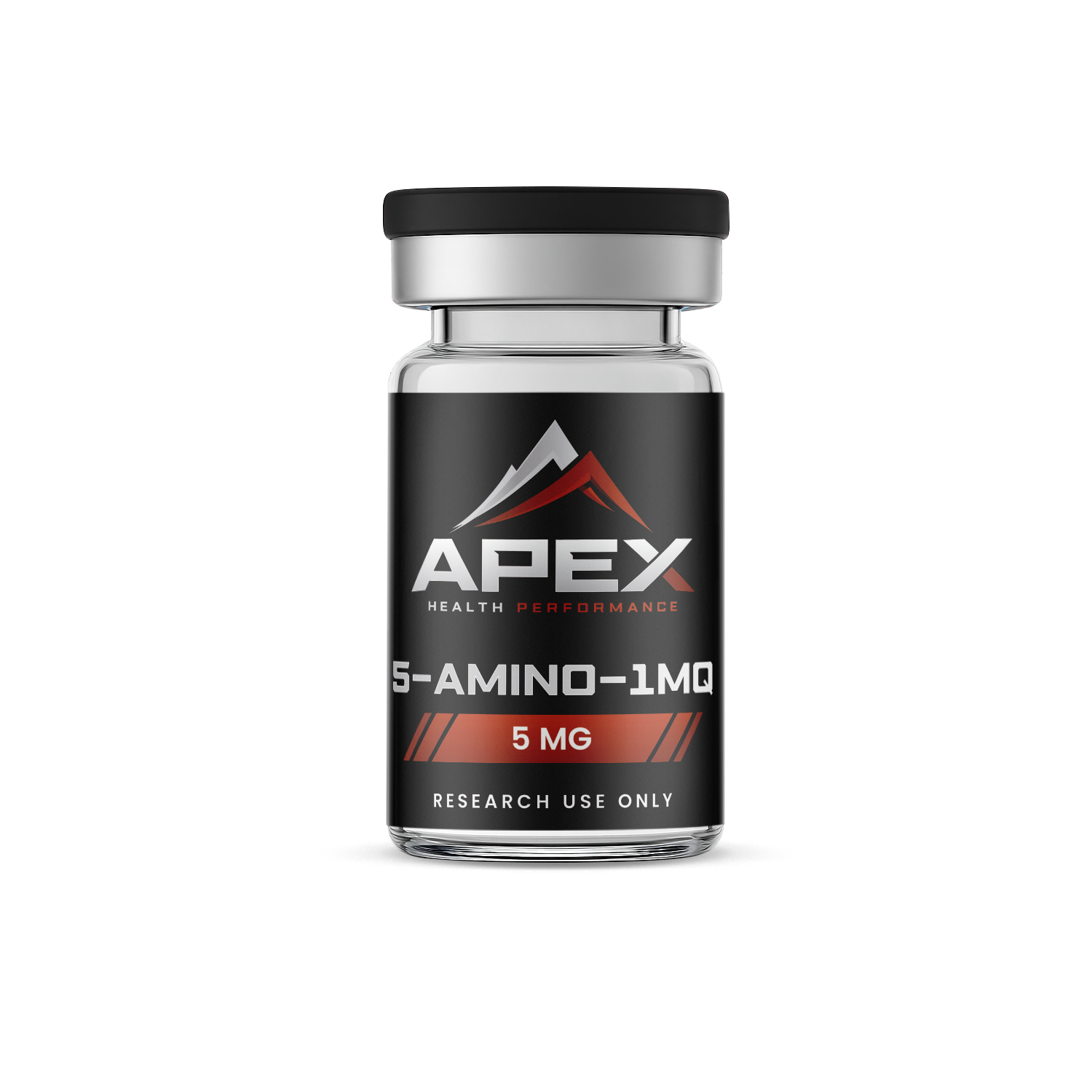
5-amino-1mq
Price range: $50.00 through $220.00
1 published certificate
Certificate information is temporarily unavailable.
Description
A single-component research material supplied for controlled research environments. 5-amino-1MQ (5 mg) is a small-molecule compound studied for its role as a selective NNMT (nicotinamide N-methyltransferase) inhibitor in metabolic and cellular energy research.Not for human use.
Documentation & Quality Assurance
Each lot is sourced through our verified global supply chain with emphasis on traceability and quality control.These documents are reviewed internally and displayed as they become available.
Important Notice
This product is intended for laboratory research use only. It is not intended for human or veterinary use, and must not be used for diagnostic, therapeutic, or clinical purposes.
This material is not a drug, medical device, or dietary supplement, and has not been evaluated by the U.S. Food and Drug Administration.
Quality & Manufacturing
We work directly with the manufacturers. Each supplier is reviewed for reliability, documentation integrity, and transparency in testing.
Our minimum purity standard is 98%. Every batch we ship has its own certificate of analysis, and every certificate confirms identity, purity and net content. Where available, endotoxin testing results are included on Certificates of Analysis to verify laboratory purity; their inclusion is for research quality assessment only and does not imply suitability for human or veterinary use.
All research materials are sealed for integrity and packaged for stability during storage and transport from manufacturing through final delivery.
Additional information
| Weight | 0.0625 lbs |
|---|---|
| Dosage | 5mg, 50mg |
Certificate of Analysis
Every batch undergoes independent third-party laboratory analysis to verify identity, potency, and safety. Testing includes quantitative assay verification, heavy metals screening, and comprehensive microbial analysis.
All Available COAs
Storage Instructions
All products from Apex Health Performance are manufactured using a lyophilization (freeze-drying) process. This method is designed to maintain product integrity and allows vials to remain stable during shipping for approximately 3–4 months.
Once a vial is reconstituted with bacteriostatic water, it should be stored in the refrigerator to help maintain stability. Under these conditions, reconstituted material is generally considered stable for up to 30 days.
Lyophilization is a dehydration technique in which compounds are frozen and then exposed to low pressure. This causes the water in the vial to sublimate directly from solid to gas, leaving behind a stable, crystalline white structure. This powder can be kept at room temperature until reconstitution.
Upon receipt, products should be stored away from heat and light. For short-term use, refrigeration at approximately 4°C (39°F) is suitable. For long-term storage (several months to years), vials may be placed in a freezer at approximately -80°C (-112°F). Freezing is the preferred method for preserving product stability over extended periods.
⚠️ Important Notice:
These products are intended for research use only. Not for human consumption.
Related products
Research Use Only
The following peer-reviewed publications reference compounds for laboratory and in vitro research purposes only. Not for human or animal use. Not intended to diagnose, treat, cure, or prevent any disease or condition.
Published Scientific Research
Peer-reviewed laboratory studies investigating metabolic research peptides
Designed Peptide Assemblies for Efficient Gene Delivery.
The de novo designed peptides not only can induce efficient condensation of nucleic acids into compacted nanoparticles and protect them from enzymatic digestion but also can effectively overcome biological barriers and improve gene delivery efficiency through targeted delivery, enhanced cellular uptake, improved endolysosomal escape, and nuclear importation.
View Full Study on PubMedSelf-assembling Molecular Medicine for the Subacute Phase of Ischemic Stroke.
Ischemic stroke leads to acute neuron death and forms an injured core, triggering delayed cell death at the penumbra. The impaired brain functions after ischemic stroke are hardly recovered because of the limited regenerative properties. However, recent rodent intervention studies manipulating the extracellular environments at the subacute phase shed new light on the regenerative potency of the injured brain. This review introduces the rational design of artificial extracellular matrix (ECM) mim
View Full Study on PubMedPeptide-based coacervates as biomimetic protocells.
Coacervates are condensed liquid-like droplets formed by liquid-liquid phase separation of molecules through multiple weak associative interactions. In recent years it has emerged that not only long polymers, but also short peptides are capable of forming simple and complex coacervates. The coacervate droplets they form act as compartments that sequester and concentrate a wide range of solutes, and their spontaneous formation make coacervates attractive protocell models. The main advantage of pe
View Full Study on PubMedTargeting Tumors Using Peptides.
To penetrate solid tumors, low molecular weight (Mw < 10 KDa) compounds have an edge over antibodies: their higher penetration because of their small size. Because of the dense stroma and high interstitial fluid pressure of solid tumors, the penetration of higher Mw compounds is unfavored and being small thus becomes an advantage. This review covers a wide range of peptidic ligands-linear, cyclic, macrocyclic and cyclotidic peptides-to target tumors: We describe the main tools to identify peptid
View Full Study on PubMedMechanisms Inspired Targeting Peptides.
Peptides targeting ligands or receptors in CIP have been designed based on three-dimensional structures of target proteins or directly selected by random peptide libraries in biological display systems.
View Full Study on PubMedCytosolic delivery of peptidic STAT3 SH2 domain inhibitors.
The signal transducer and activator of transcription 3 (STAT3) protein is constitutively activated in several cancers. STAT3 activity can be blocked by inhibiting its Src Homology 2 (SH2) domain, but phosphotyrosine and its isosteres have poor bioavailability. In this work, we develop peptide-based inhibitors of STAT3-SH2 by combining chemical strategies that have proven effective for targeting other SH2 domains. These strategies include a STAT3-specific selectivity sequence, non-hydrolyzable ph
View Full Study on PubMedResearch Use Only
The following peer-reviewed publications reference compounds for laboratory and in vitro research purposes only. Not for human or animal use. Not intended to diagnose, treat, cure, or prevent any disease or condition.
Published Scientific Research
Peer-reviewed laboratory studies investigating metabolic research peptides
Designed Peptide Assemblies for Efficient Gene Delivery.
The de novo designed peptides not only can induce efficient condensation of nucleic acids into compacted nanoparticles and protect them from enzymatic digestion but also can effectively overcome biological barriers and improve gene delivery efficiency through targeted delivery, enhanced cellular uptake, improved endolysosomal escape, and nuclear importation.
View Full Study on PubMedSelf-assembling Molecular Medicine for the Subacute Phase of Ischemic Stroke.
Ischemic stroke leads to acute neuron death and forms an injured core, triggering delayed cell death at the penumbra. The impaired brain functions after ischemic stroke are hardly recovered because of the limited regenerative properties. However, recent rodent intervention studies manipulating the extracellular environments at the subacute phase shed new light on the regenerative potency of the injured brain. This review introduces the rational design of artificial extracellular matrix (ECM) mim
View Full Study on PubMedPeptide-based coacervates as biomimetic protocells.
Coacervates are condensed liquid-like droplets formed by liquid-liquid phase separation of molecules through multiple weak associative interactions. In recent years it has emerged that not only long polymers, but also short peptides are capable of forming simple and complex coacervates. The coacervate droplets they form act as compartments that sequester and concentrate a wide range of solutes, and their spontaneous formation make coacervates attractive protocell models. The main advantage of pe
View Full Study on PubMedTargeting Tumors Using Peptides.
To penetrate solid tumors, low molecular weight (Mw < 10 KDa) compounds have an edge over antibodies: their higher penetration because of their small size. Because of the dense stroma and high interstitial fluid pressure of solid tumors, the penetration of higher Mw compounds is unfavored and being small thus becomes an advantage. This review covers a wide range of peptidic ligands-linear, cyclic, macrocyclic and cyclotidic peptides-to target tumors: We describe the main tools to identify peptid
View Full Study on PubMedMechanisms Inspired Targeting Peptides.
Peptides targeting ligands or receptors in CIP have been designed based on three-dimensional structures of target proteins or directly selected by random peptide libraries in biological display systems.
View Full Study on PubMedCytosolic delivery of peptidic STAT3 SH2 domain inhibitors.
The signal transducer and activator of transcription 3 (STAT3) protein is constitutively activated in several cancers. STAT3 activity can be blocked by inhibiting its Src Homology 2 (SH2) domain, but phosphotyrosine and its isosteres have poor bioavailability. In this work, we develop peptide-based inhibitors of STAT3-SH2 by combining chemical strategies that have proven effective for targeting other SH2 domains. These strategies include a STAT3-specific selectivity sequence, non-hydrolyzable ph
View Full Study on PubMedResearch Use Only
The following peer-reviewed publications reference compounds for laboratory and in vitro research purposes only. Not for human or animal use. Not intended to diagnose, treat, cure, or prevent any disease or condition.
Published Scientific Research
Peer-reviewed laboratory studies investigating metabolic research peptides
Designed Peptide Assemblies for Efficient Gene Delivery.
The de novo designed peptides not only can induce efficient condensation of nucleic acids into compacted nanoparticles and protect them from enzymatic digestion but also can effectively overcome biological barriers and improve gene delivery efficiency through targeted delivery, enhanced cellular uptake, improved endolysosomal escape, and nuclear importation.
View Full Study on PubMed →Self-assembling Molecular Medicine for the Subacute Phase of Ischemic Stroke.
Ischemic stroke leads to acute neuron death and forms an injured core, triggering delayed cell death at the penumbra. The impaired brain functions after ischemic stroke are hardly recovered because of the limited regenerative properties. However, recent rodent intervention studies manipulating the extracellular environments at the subacute phase shed new light on the regenerative potency of the injured brain. This review introduces the rational design of artificial extracellular matrix (ECM) mim
View Full Study on PubMed →Peptide-based coacervates as biomimetic protocells.
Coacervates are condensed liquid-like droplets formed by liquid-liquid phase separation of molecules through multiple weak associative interactions. In recent years it has emerged that not only long polymers, but also short peptides are capable of forming simple and complex coacervates. The coacervate droplets they form act as compartments that sequester and concentrate a wide range of solutes, and their spontaneous formation make coacervates attractive protocell models. The main advantage of pe
View Full Study on PubMed →Targeting Tumors Using Peptides.
To penetrate solid tumors, low molecular weight (Mw < 10 KDa) compounds have an edge over antibodies: their higher penetration because of their small size. Because of the dense stroma and high interstitial fluid pressure of solid tumors, the penetration of higher Mw compounds is unfavored and being small thus becomes an advantage. This review covers a wide range of peptidic ligands-linear, cyclic, macrocyclic and cyclotidic peptides-to target tumors: We describe the main tools to identify peptid
View Full Study on PubMed →Mechanisms Inspired Targeting Peptides.
Peptides targeting ligands or receptors in CIP have been designed based on three-dimensional structures of target proteins or directly selected by random peptide libraries in biological display systems.
View Full Study on PubMed →Cytosolic delivery of peptidic STAT3 SH2 domain inhibitors.
The signal transducer and activator of transcription 3 (STAT3) protein is constitutively activated in several cancers. STAT3 activity can be blocked by inhibiting its Src Homology 2 (SH2) domain, but phosphotyrosine and its isosteres have poor bioavailability. In this work, we develop peptide-based inhibitors of STAT3-SH2 by combining chemical strategies that have proven effective for targeting other SH2 domains. These strategies include a STAT3-specific selectivity sequence, non-hydrolyzable ph
View Full Study on PubMed →Important Research Notice: These products are research chemicals intended exclusively for in vitro laboratory research by qualified professionals. Not for human or animal consumption. Not approved by the FDA for any therapeutic purpose. Sold strictly for scientific research applications only.