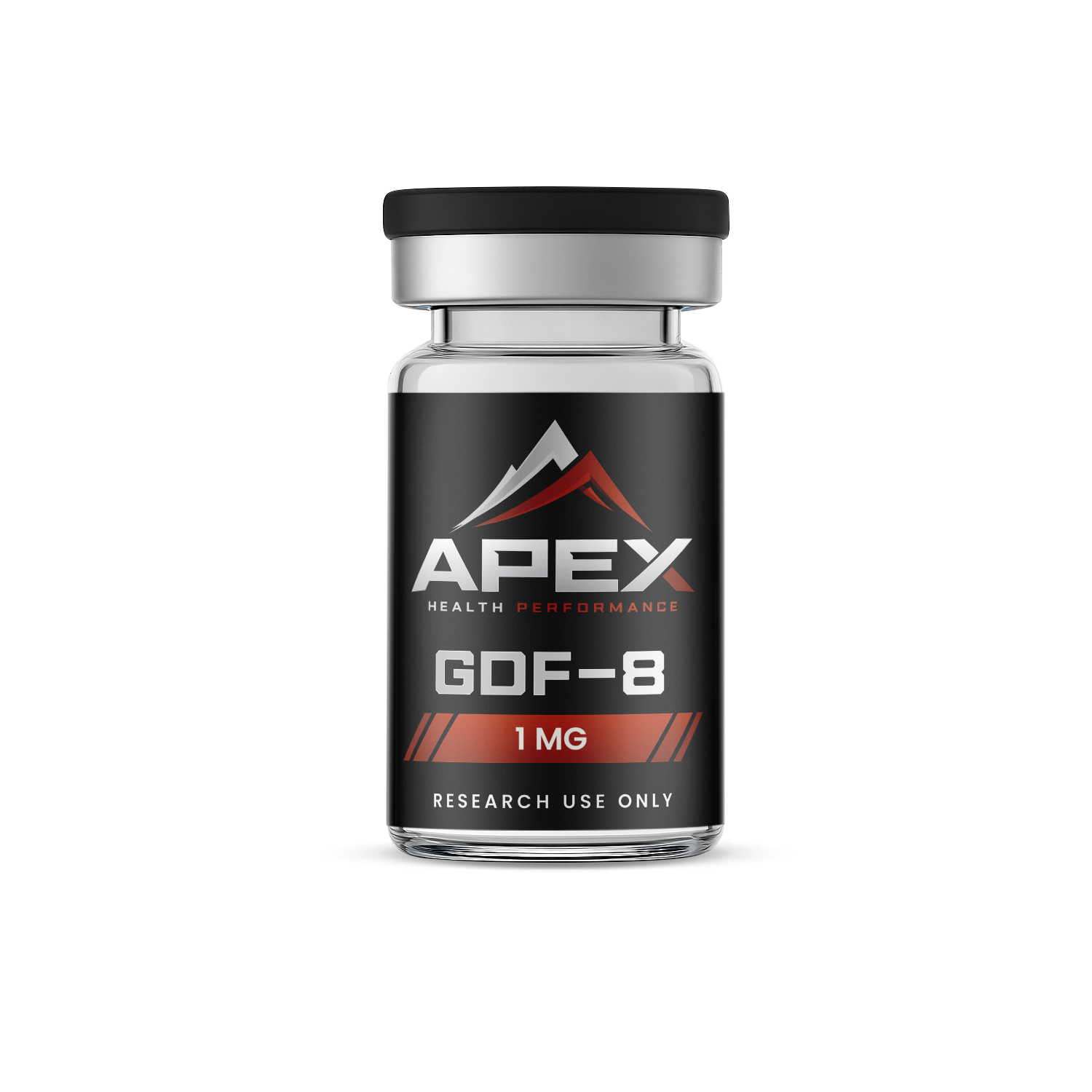
GDF-8 (1mg)
$240.00
Certificate information is temporarily unavailable.
Description
A single-component research material supplied for controlled research environments. GDF-8 (1 mg), also known as Myostatin, is a recombinant protein used in research examining muscle growth regulation, TGF-β superfamily signaling, and related molecular pathways in controlled laboratory models.
Composition
• GDF-8 (Myostatin)
• Appearance: Lyophilized powder in a sealed research vial
Research Focus (non-clinical)
• Structural and functional analysis of Myostatin in muscle cell models
• Investigation of TGF-β pathway signaling and receptor interactions
• Assay development for measuring Myostatin activity and inhibition
• Stability and solubility profiling under laboratory storage conditions
For qualified research professionals and institutional laboratories. Not for human use.
Documentation & Quality Assurance
Each lot is sourced through our verified global supply chain with emphasis on traceability and quality control.These documents are reviewed internally and displayed as they become available.
Important Notice
This product is intended for laboratory research use only. It is not intended for human or veterinary use, and must not be used for diagnostic, therapeutic, or clinical purposes.
This material is not a drug, medical device, or dietary supplement, and has not been evaluated by the U.S. Food and Drug Administration.
Quality & Manufacturing
We work directly with the manufacturers. Each supplier is reviewed for reliability, documentation integrity, and transparency in testing.
Our minimum purity standard is 98%. Every batch we ship has its own certificate of analysis, and every certificate confirms identity, purity and net content. Where available, endotoxin testing results are included on Certificates of Analysis to verify laboratory purity; their inclusion is for research quality assessment only and does not imply suitability for human or veterinary use.
All research materials are sealed for integrity and packaged for stability during storage and transport from manufacturing through final delivery.
Additional information
| Weight | 0.0625 lbs |
|---|
Certificate of Analysis
Every batch undergoes independent third-party laboratory analysis to verify identity, potency, and safety. Testing includes quantitative assay verification, heavy metals screening, and comprehensive microbial analysis.
View Certificate of AnalysisStorage Instructions
All products from Apex Health Performance are manufactured using a lyophilization (freeze-drying) process. This method is designed to maintain product integrity and allows vials to remain stable during shipping for approximately 3–4 months.
Once a vial is reconstituted with bacteriostatic water, it should be stored in the refrigerator to help maintain stability. Under these conditions, reconstituted material is generally considered stable for up to 30 days.
Lyophilization is a dehydration technique in which compounds are frozen and then exposed to low pressure. This causes the water in the vial to sublimate directly from solid to gas, leaving behind a stable, crystalline white structure. This powder can be kept at room temperature until reconstitution.
Upon receipt, products should be stored away from heat and light. For short-term use, refrigeration at approximately 4°C (39°F) is suitable. For long-term storage (several months to years), vials may be placed in a freezer at approximately -80°C (-112°F). Freezing is the preferred method for preserving product stability over extended periods.
⚠️ Important Notice:
These products are intended for research use only. Not for human consumption.
Related products
Research Use Only
The following peer-reviewed publications reference compounds for laboratory and in vitro research purposes only. Not for human or animal use. Not intended to diagnose, treat, cure, or prevent any disease or condition.
Published Scientific Research
Peer-reviewed laboratory studies investigating research peptides
Semaglutide-Induced Sarcopenia via GLP-1R-mTOR-Satellite Cells Axis and Muscle-Glucose Feedback Loop Potentially Leading to Refractory Hyperglycemia in Type 2 Diabetes: A Case-Driven Hypothesis.
Glucagon-like peptide-1 receptor agonists (GLP-1RAs) like semaglutide have transformed type 2 diabetes mellitus (T2DM) management, yet emerging concerns highlight potential risks of accelerated sarcopenia and subsequent metabolic disruptions. Transition to dulaglutide 1.5 mg for 1.5 years followed by semaglutide (titrated from 0.25 to 1 mg weekly starting September 2024) resulted in weight loss from 84 kg to 70 kg by September 2025, accompanied by sarcopenic symptoms (muscle weakness, reduced mobility) and refractory hyperglycemia (fasting glucose 300 mg/dL, HbA1c 9%), persisting post-discontinuation on September 1, 2025, despite metformin and empagliflozin.
View Full Study on PubMedDecoding the Heart Failure Peptidome.
BACKGROUND: Peptides such as angiotensin II and brain natriuretic peptide are pivotal in diagnosing and treating heart failure (HF). However, unbiased systematic studies of the peptidome in patients with HF are lacking. Deciphering the plasma peptidome might significantly improve the diagnosis, prognostication, and treatment of patients with HF. METHODS: To systematically explore the low molecular peptidome, we conducted a cross-sectional mass spectrometry analysis from 486 patients with HF and
View Full Study on PubMedMolecular mechanism of Activin receptor inhibition by DLK1.
Delta-like non-canonical Notch ligand 1 (DLK1) influences myogenesis, adipogenesis, and other aspects of human development through a process that is largely attributed to the downregulation of Notch signaling. Here, we show that DLK1 does not bind to Notch receptors or affect ligand-mediated Notch activation, but instead engages the TGF-β superfamily member Activin receptor type 2B (ACVR2B).
View Full Study on PubMedPeptides: Emerging Candidates for the Prevention and Treatment of Skin Senescence: A Review.
Based on their mechanism of action, they can be classified into signal peptides, carrier peptides, neurotransmitter inhibitor peptides, and enzyme inhibitor peptides. Increasing peptide bioavailability and stability for enhanced delivery to the desired site of action and visible effects have become central points for the latest research due to their promising features.
View Full Study on PubMedBioactive peptides in cosmetic formulations: Review of current in vitro and ex vivo evidence.
Their claimed biological activities include signaling to increase collagen and hyaluronic acid production, modulation of pigmentation, maintenance of a healthy skin microbiome, antioxidant activity and cellular defense, immunomodulation, neurotransmitter inhibition, enzyme activity inhibition and trace mineral carriers.
View Full Study on PubMedVasostatin-2 attenuates injury-induced neointimal hyperplasia through the ACE2/MasR/PPARγ/NR1D1/Gas1 axis.
However, its role in injury-induced vascular remodelling remains unclear. A combination of multi-omics (Bulk RNA sequencing, CUT&Tag detection, and glutathione S-transferase pull-down/mass spectrometry analysis) was employed to investigate underlying mechanisms.
View Full Study on PubMedResearch Use Only
The following peer-reviewed publications reference compounds for laboratory and in vitro research purposes only. Not for human or animal use. Not intended to diagnose, treat, cure, or prevent any disease or condition.
Published Scientific Research
Peer-reviewed laboratory studies investigating research peptides
Fat, muscle, and anti-obesity medications in cardiovascular disease prevention.
The rapid expansion of anti-obesity treatments with glucagon-like peptide-1 receptor agonists has redefined weight management. Emerging agents targeting the myostatin/activin pathway, ligand traps, and selective androgen receptor modulators may increase muscle quality and have synergistic benefit with incretin-based therapies.
View Full Study on PubMedMolecular mechanism of Activin receptor inhibition by DLK1.
Delta-like non-canonical Notch ligand 1 (DLK1) influences myogenesis, adipogenesis, and other aspects of human development through a process that is largely attributed to the downregulation of Notch signaling. Here, we show that DLK1 does not bind to Notch receptors or affect ligand-mediated Notch activation, but instead engages the TGF-β superfamily member Activin receptor type 2B (ACVR2B).
View Full Study on PubMedA molecular pathway for cancer cachexia-induced muscle atrophy revealed at single-nucleus resolution.
Muscle atrophy is a central component of the syndrome, but the mechanisms whereby cancer leads to skeletal muscle atrophy are not well understood. Our results revealed the activation of a denervation-dependent gene program that upregulates the transcription factor myogenin.
View Full Study on PubMedCrosstalk between muscle and bone.
Signaling by these myokines has potential as a target for drug development and biomarkers for exercise.
View Full Study on PubMedMyostatin: A Skeletal Muscle Chalone.
The elucidation of the molecular, cellular, and physiological mechanisms underlying myostatin activity suggests that myostatin functions as a negative feedback regulator of muscle mass and raises the question as to whether this type of chalone mechanism is unique to skeletal muscle or whether it also operates in other tissues.
View Full Study on PubMedMolecular mechanisms of cancer cachexia-related loss of skeletal muscle mass: data analysis from preclinical and clinical studies.
Differences in the molecular and biochemical responses of skeletal muscle to cancer cachexia between human and animals (protein turnover rates, regulation of ubiquitin-proteasome system and myostatin/activin A-SMAD2/3 signalling pathways) are highlighted and discussed.
View Full Study on PubMedResearch Use Only
The following peer-reviewed publications reference compounds for laboratory and in vitro research purposes only. Not for human or animal use. Not intended to diagnose, treat, cure, or prevent any disease or condition.
Published Scientific Research
Peer-reviewed laboratory studies investigating research peptides
Semaglutide-Induced Sarcopenia via GLP-1R-mTOR-Satellite Cells Axis and Muscle-Glucose Feedback Loop Potentially Leading to Refractory Hyperglycemia in Type 2 Diabetes: A Case-Driven Hypothesis.
Glucagon-like peptide-1 receptor agonists (GLP-1RAs) like semaglutide have transformed type 2 diabetes mellitus (T2DM) management, yet emerging concerns highlight potential risks of accelerated sarcopenia and subsequent metabolic disruptions. Transition to dulaglutide 1.5 mg for 1.5 years followed by semaglutide (titrated from 0.25 to 1 mg weekly starting September 2024) resulted in weight loss from 84 kg to 70 kg by September 2025, accompanied by sarcopenic symptoms (muscle weakness, reduced mobility) and refractory hyperglycemia (fasting glucose 300 mg/dL, HbA1c 9%), persisting post-discontinuation on September 1, 2025, despite metformin and empagliflozin.
View Full Study on PubMed →Decoding the Heart Failure Peptidome.
BACKGROUND: Peptides such as angiotensin II and brain natriuretic peptide are pivotal in diagnosing and treating heart failure (HF). However, unbiased systematic studies of the peptidome in patients with HF are lacking. Deciphering the plasma peptidome might significantly improve the diagnosis, prognostication, and treatment of patients with HF. METHODS: To systematically explore the low molecular peptidome, we conducted a cross-sectional mass spectrometry analysis from 486 patients with HF and
View Full Study on PubMed →Molecular mechanism of Activin receptor inhibition by DLK1.
Delta-like non-canonical Notch ligand 1 (DLK1) influences myogenesis, adipogenesis, and other aspects of human development through a process that is largely attributed to the downregulation of Notch signaling. Here, we show that DLK1 does not bind to Notch receptors or affect ligand-mediated Notch activation, but instead engages the TGF-β superfamily member Activin receptor type 2B (ACVR2B).
View Full Study on PubMed →Peptides: Emerging Candidates for the Prevention and Treatment of Skin Senescence: A Review.
Based on their mechanism of action, they can be classified into signal peptides, carrier peptides, neurotransmitter inhibitor peptides, and enzyme inhibitor peptides. Increasing peptide bioavailability and stability for enhanced delivery to the desired site of action and visible effects have become central points for the latest research due to their promising features.
View Full Study on PubMed →Bioactive peptides in cosmetic formulations: Review of current in vitro and ex vivo evidence.
Their claimed biological activities include signaling to increase collagen and hyaluronic acid production, modulation of pigmentation, maintenance of a healthy skin microbiome, antioxidant activity and cellular defense, immunomodulation, neurotransmitter inhibition, enzyme activity inhibition and trace mineral carriers.
View Full Study on PubMed →Vasostatin-2 attenuates injury-induced neointimal hyperplasia through the ACE2/MasR/PPARγ/NR1D1/Gas1 axis.
However, its role in injury-induced vascular remodelling remains unclear. A combination of multi-omics (Bulk RNA sequencing, CUT&Tag detection, and glutathione S-transferase pull-down/mass spectrometry analysis) was employed to investigate underlying mechanisms.
View Full Study on PubMed →Important Research Notice: These products are research chemicals intended exclusively for in vitro laboratory research by qualified professionals. Not for human or animal consumption. Not approved by the FDA for any therapeutic purpose. Sold strictly for scientific research applications only.