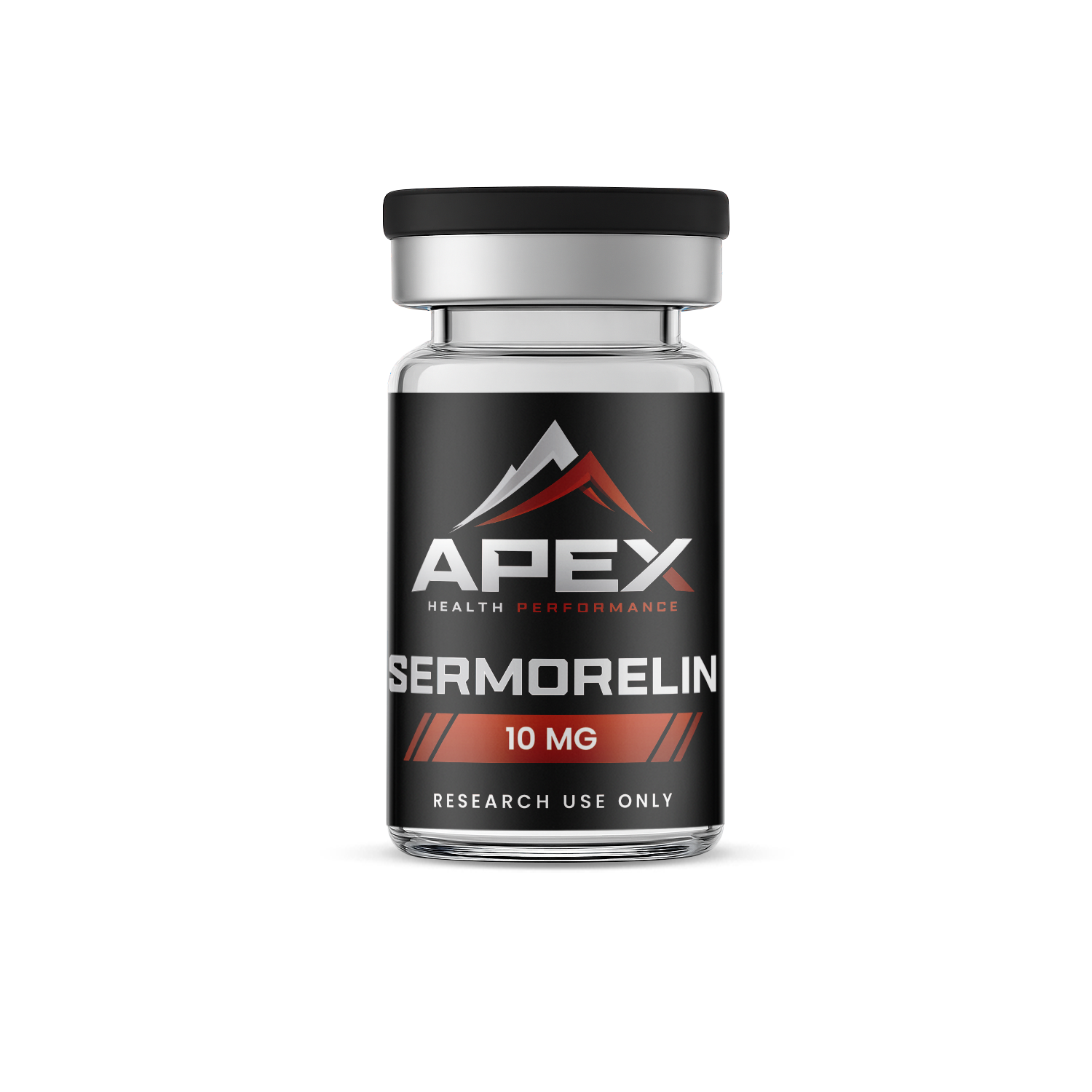
Sermorelin (10mg)
$100.00
3 published certificates
Certificate information is temporarily unavailable.
Description
A single-component research material supplied for controlled research environments. Suitable for studies involving GHRH-receptor pathway characterization and method development in model systems.Not for human use.
Documentation & Quality Assurance
Each lot is sourced through our verified global supply chain with emphasis on traceability and quality control.These documents are reviewed internally and displayed as they become available.
Important Notice
This product is intended for laboratory research use only. It is not intended for human or veterinary use, and must not be used for diagnostic, therapeutic, or clinical purposes.
This material is not a drug, medical device, or dietary supplement, and has not been evaluated by the U.S. Food and Drug Administration.
Quality & Manufacturing
We work directly with the manufacturers. Each supplier is reviewed for reliability, documentation integrity, and transparency in testing.
Our minimum purity standard is 98%. Every batch we ship has its own certificate of analysis, and every certificate confirms identity, purity and net content. Where available, endotoxin testing results are included on Certificates of Analysis to verify laboratory purity; their inclusion is for research quality assessment only and does not imply suitability for human or veterinary use.
All research materials are sealed for integrity and packaged for stability during storage and transport from manufacturing through final delivery.
Additional information
| Weight | 0.0625 lbs |
|---|
Certificate of Analysis
Every batch undergoes independent third-party laboratory analysis to verify identity, potency, and safety. Testing includes quantitative assay verification, heavy metals screening, and comprehensive microbial analysis.
View Certificate of AnalysisStorage Instructions
All products from Apex Health Performance are manufactured using a lyophilization (freeze-drying) process. This method is designed to maintain product integrity and allows vials to remain stable during shipping for approximately 3–4 months.
Once a vial is reconstituted with bacteriostatic water, it should be stored in the refrigerator to help maintain stability. Under these conditions, reconstituted material is generally considered stable for up to 30 days.
Lyophilization is a dehydration technique in which compounds are frozen and then exposed to low pressure. This causes the water in the vial to sublimate directly from solid to gas, leaving behind a stable, crystalline white structure. This powder can be kept at room temperature until reconstitution.
Upon receipt, products should be stored away from heat and light. For short-term use, refrigeration at approximately 4°C (39°F) is suitable. For long-term storage (several months to years), vials may be placed in a freezer at approximately -80°C (-112°F). Freezing is the preferred method for preserving product stability over extended periods.
⚠️ Important Notice:
These products are intended for research use only. Not for human consumption.
Related products
Research Use Only
The following peer-reviewed publications reference compounds for laboratory and in vitro research purposes only. Not for human or animal use. Not intended to diagnose, treat, cure, or prevent any disease or condition.
Published Scientific Research
Peer-reviewed laboratory studies investigating growth hormone peptides
A new era of doping? Use of peptide and peptide-analog drugs in recreational and professional sport and bodybuilding: a critical review.
Marketed as more selective and ostensibly safer alternatives, peptides-including growth hormone secretagogues (e.g., Ipamorelin), growth hormone-releasing hormone analogues (e.g., CJC-1295, Sermorelin), and synthetic fragments (e.g., Frag 176-191, KPV)-are promoted for muscle growth, fat metabolism, recovery, and anti-inflammatory effects. Their pharmacological profiles, including enhanced stability and receptor selectivity, have made them attractive in both medical research and bodybuilding communities.
View Full Study on PubMedProbing for peptidic drugs (2-10 kDa) in doping control blood samples.
Bioactive peptides with a molecular mass between 2 and 10 kDa represent an important class of substances banned in elite sports, which has been recognized with an increasing number and variety of substances by anti-doping organizations. Also, the annually renewed list of prohibited substances of the World Anti-Doping Agency (WADA) explicitly mentions more and more of these peptides, and efficient testing procedures are required. Even under simplified sample preparation conditions, liquid chroma
View Full Study on PubMedAdvances in the detection of growth hormone releasing hormone synthetic analogs.
The administration of growth hormone releasing hormone (GHRH) and its synthetic analogs is prohibited by the World Anti-Doping Agency (WADA). Although there is evidence of their use, based on admissions and intelligence, they do not appear to have been found in anti-doping samples by WADA accredited laboratories. This might be due to their small concentration in urine and limited knowledge about their metabolism, especially for unapproved synthetic analogs. This study investigates the in vitro m
View Full Study on PubMedA glimpse at growth hormone-releasing hormone cosmos.
Those peptides support lung endothelial barrier integrity by suppressing major inflammatory pathways and by inducing the endothelial defender P53. The present effort provides information regarding the effects of growth hormone-releasing hormone in the regulation of P53 and the unfolded protein response.
View Full Study on PubMedInhibition of experimental small-cell and non-small-cell lung cancers by novel antagonists of growth hormone-releasing hormone.
Western blot and qRT-PCR analyses demonstrated a downregulation of expression of the pituitary-type GHRH-R and its splice-variant, cyclinD1/2, cyclin-dependent kinase4/6, p21-activated kinase-1, phosphorylation of activator of transcription 3 and cAMP response element binding protein; and an upregulation of expression of E-cadherin, β-catenin and P27 in cancer cells and in xenografted tumor tissues. The study demonstrates the involvement of GHRH antagonists in multiple signaling pathways in lung cancers.
View Full Study on PubMedQualitative identification of growth hormone-releasing hormones in human plasma by means of immunoaffinity purification and LC-HRMS/MS.
The use of growth hormone-releasing hormones (GHRHs) is prohibited in sports according to the regulations of the World Anti-Doping Agency (WADA). The aim of the present study was to develop a method for the simultaneous detection of four different GHRHs and respective metabolites from human plasma by means of immunoaffinity purification and subsequent nano-ultrahigh performance liquid chromatography-high resolution/high accuracy (tandem) mass spectrometry. The target analytes included Geref (Ser
View Full Study on PubMedResearch Use Only
The following peer-reviewed publications reference compounds for laboratory and in vitro research purposes only. Not for human or animal use. Not intended to diagnose, treat, cure, or prevent any disease or condition.
Published Scientific Research
Peer-reviewed laboratory studies investigating growth hormone peptides
A new era of doping? Use of peptide and peptide-analog drugs in recreational and professional sport and bodybuilding: a critical review.
Marketed as more selective and ostensibly safer alternatives, peptides-including growth hormone secretagogues (e.g., Ipamorelin), growth hormone-releasing hormone analogues (e.g., CJC-1295, Sermorelin), and synthetic fragments (e.g., Frag 176-191, KPV)-are promoted for muscle growth, fat metabolism, recovery, and anti-inflammatory effects. Their pharmacological profiles, including enhanced stability and receptor selectivity, have made them attractive in both medical research and bodybuilding communities.
View Full Study on PubMedProbing for peptidic drugs (2-10 kDa) in doping control blood samples.
Bioactive peptides with a molecular mass between 2 and 10 kDa represent an important class of substances banned in elite sports, which has been recognized with an increasing number and variety of substances by anti-doping organizations. Also, the annually renewed list of prohibited substances of the World Anti-Doping Agency (WADA) explicitly mentions more and more of these peptides, and efficient testing procedures are required. Even under simplified sample preparation conditions, liquid chroma
View Full Study on PubMedAdvances in the detection of growth hormone releasing hormone synthetic analogs.
The administration of growth hormone releasing hormone (GHRH) and its synthetic analogs is prohibited by the World Anti-Doping Agency (WADA). Although there is evidence of their use, based on admissions and intelligence, they do not appear to have been found in anti-doping samples by WADA accredited laboratories. This might be due to their small concentration in urine and limited knowledge about their metabolism, especially for unapproved synthetic analogs. This study investigates the in vitro m
View Full Study on PubMedA glimpse at growth hormone-releasing hormone cosmos.
Those peptides support lung endothelial barrier integrity by suppressing major inflammatory pathways and by inducing the endothelial defender P53. The present effort provides information regarding the effects of growth hormone-releasing hormone in the regulation of P53 and the unfolded protein response.
View Full Study on PubMedInhibition of experimental small-cell and non-small-cell lung cancers by novel antagonists of growth hormone-releasing hormone.
Western blot and qRT-PCR analyses demonstrated a downregulation of expression of the pituitary-type GHRH-R and its splice-variant, cyclinD1/2, cyclin-dependent kinase4/6, p21-activated kinase-1, phosphorylation of activator of transcription 3 and cAMP response element binding protein; and an upregulation of expression of E-cadherin, β-catenin and P27 in cancer cells and in xenografted tumor tissues. The study demonstrates the involvement of GHRH antagonists in multiple signaling pathways in lung cancers.
View Full Study on PubMedQualitative identification of growth hormone-releasing hormones in human plasma by means of immunoaffinity purification and LC-HRMS/MS.
The use of growth hormone-releasing hormones (GHRHs) is prohibited in sports according to the regulations of the World Anti-Doping Agency (WADA). The aim of the present study was to develop a method for the simultaneous detection of four different GHRHs and respective metabolites from human plasma by means of immunoaffinity purification and subsequent nano-ultrahigh performance liquid chromatography-high resolution/high accuracy (tandem) mass spectrometry. The target analytes included Geref (Ser
View Full Study on PubMedResearch Use Only
The following peer-reviewed publications reference compounds for laboratory and in vitro research purposes only. Not for human or animal use. Not intended to diagnose, treat, cure, or prevent any disease or condition.
Published Scientific Research
Peer-reviewed laboratory studies investigating growth hormone peptides
A new era of doping? Use of peptide and peptide-analog drugs in recreational and professional sport and bodybuilding: a critical review.
Marketed as more selective and ostensibly safer alternatives, peptides-including growth hormone secretagogues (e.g., Ipamorelin), growth hormone-releasing hormone analogues (e.g., CJC-1295, Sermorelin), and synthetic fragments (e.g., Frag 176-191, KPV)-are promoted for muscle growth, fat metabolism, recovery, and anti-inflammatory effects. Their pharmacological profiles, including enhanced stability and receptor selectivity, have made them attractive in both medical research and bodybuilding communities.
View Full Study on PubMed →Probing for peptidic drugs (2-10 kDa) in doping control blood samples.
Bioactive peptides with a molecular mass between 2 and 10 kDa represent an important class of substances banned in elite sports, which has been recognized with an increasing number and variety of substances by anti-doping organizations. Also, the annually renewed list of prohibited substances of the World Anti-Doping Agency (WADA) explicitly mentions more and more of these peptides, and efficient testing procedures are required. Even under simplified sample preparation conditions, liquid chroma
View Full Study on PubMed →Advances in the detection of growth hormone releasing hormone synthetic analogs.
The administration of growth hormone releasing hormone (GHRH) and its synthetic analogs is prohibited by the World Anti-Doping Agency (WADA). Although there is evidence of their use, based on admissions and intelligence, they do not appear to have been found in anti-doping samples by WADA accredited laboratories. This might be due to their small concentration in urine and limited knowledge about their metabolism, especially for unapproved synthetic analogs. This study investigates the in vitro m
View Full Study on PubMed →A glimpse at growth hormone-releasing hormone cosmos.
Those peptides support lung endothelial barrier integrity by suppressing major inflammatory pathways and by inducing the endothelial defender P53. The present effort provides information regarding the effects of growth hormone-releasing hormone in the regulation of P53 and the unfolded protein response.
View Full Study on PubMed →Inhibition of experimental small-cell and non-small-cell lung cancers by novel antagonists of growth hormone-releasing hormone.
Western blot and qRT-PCR analyses demonstrated a downregulation of expression of the pituitary-type GHRH-R and its splice-variant, cyclinD1/2, cyclin-dependent kinase4/6, p21-activated kinase-1, phosphorylation of activator of transcription 3 and cAMP response element binding protein; and an upregulation of expression of E-cadherin, β-catenin and P27 in cancer cells and in xenografted tumor tissues. The study demonstrates the involvement of GHRH antagonists in multiple signaling pathways in lung cancers.
View Full Study on PubMed →Qualitative identification of growth hormone-releasing hormones in human plasma by means of immunoaffinity purification and LC-HRMS/MS.
The use of growth hormone-releasing hormones (GHRHs) is prohibited in sports according to the regulations of the World Anti-Doping Agency (WADA). The aim of the present study was to develop a method for the simultaneous detection of four different GHRHs and respective metabolites from human plasma by means of immunoaffinity purification and subsequent nano-ultrahigh performance liquid chromatography-high resolution/high accuracy (tandem) mass spectrometry. The target analytes included Geref (Ser
View Full Study on PubMed →Important Research Notice: These products are research chemicals intended exclusively for in vitro laboratory research by qualified professionals. Not for human or animal consumption. Not approved by the FDA for any therapeutic purpose. Sold strictly for scientific research applications only.