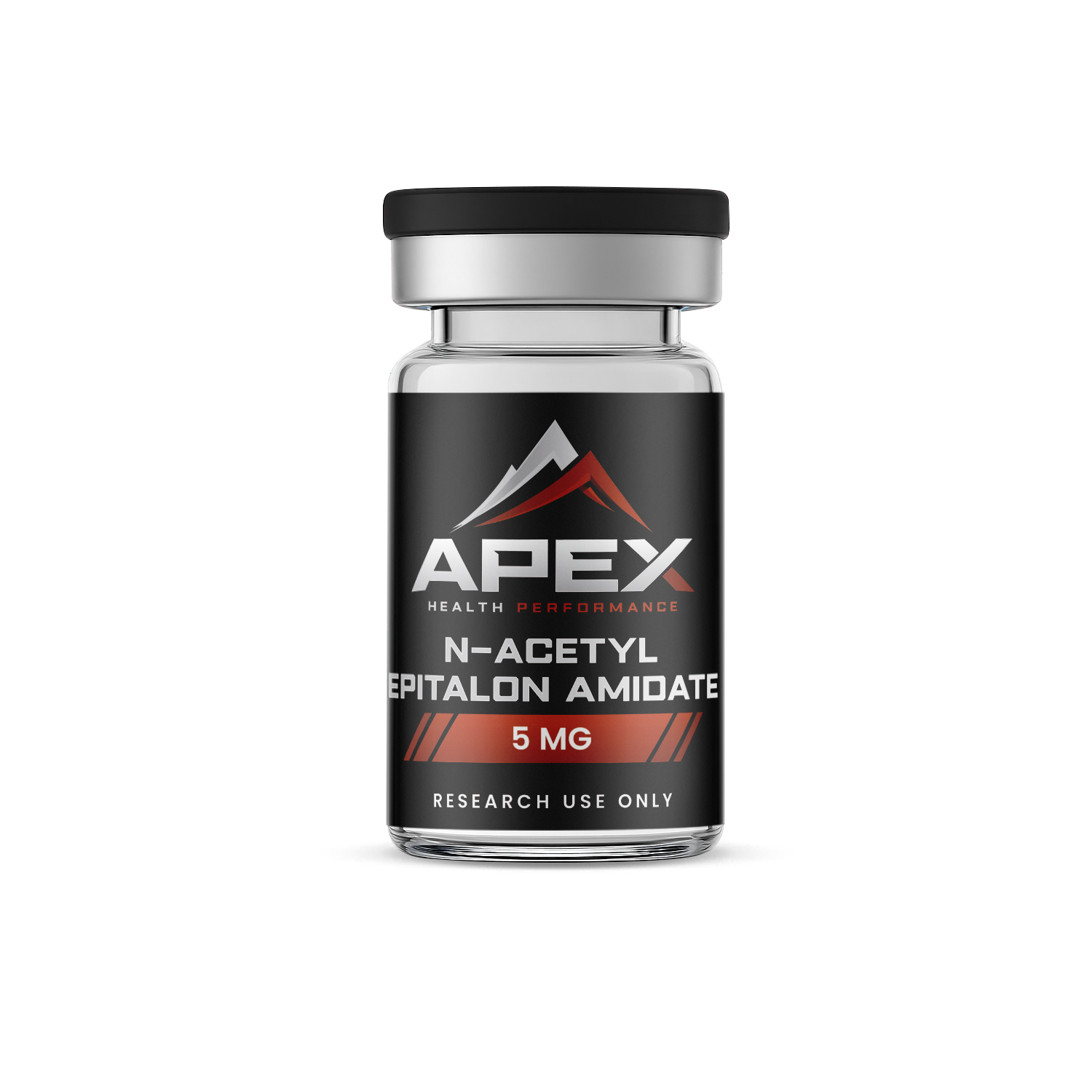
N-Acetyl Epitalon Amidate (5 mg)
$110.00
1 published certificate
Certificate information is temporarily unavailable.
Description
A single-component research material supplied for controlled research environments. N-Acetyl Epitalon Amidate (5 mg) is a synthetic tetrapeptide analog designed for research exploring telomeric activity, aging-related signaling pathways, and pineal peptide biochemistry in model systems.Not for human use.
Documentation & Quality Assurance
Each lot is sourced through our verified global supply chain with emphasis on traceability and quality control.These documents are reviewed internally and displayed as they become available.
Important Notice
This product is intended for laboratory research use only. It is not intended for human or veterinary use, and must not be used for diagnostic, therapeutic, or clinical purposes.
This material is not a drug, medical device, or dietary supplement, and has not been evaluated by the U.S. Food and Drug Administration.
Quality & Manufacturing
We work directly with the manufacturers. Each supplier is reviewed for reliability, documentation integrity, and transparency in testing.
Our minimum purity standard is 98%. Every batch we ship has its own certificate of analysis, and every certificate confirms identity, purity and net content. Where available, endotoxin testing results are included on Certificates of Analysis to verify laboratory purity; their inclusion is for research quality assessment only and does not imply suitability for human or veterinary use.
All research materials are sealed for integrity and packaged for stability during storage and transport from manufacturing through final delivery.
Additional information
| Weight | 0.0625 lbs |
|---|
Certificate of Analysis
Every batch undergoes independent third-party laboratory analysis to verify identity, potency, and safety. Testing includes quantitative assay verification, heavy metals screening, and comprehensive microbial analysis.
View Certificate of AnalysisStorage Instructions
All products from Apex Health Performance are manufactured using a lyophilization (freeze-drying) process. This method is designed to maintain product integrity and allows vials to remain stable during shipping for approximately 3–4 months.
Once a vial is reconstituted with bacteriostatic water, it should be stored in the refrigerator to help maintain stability. Under these conditions, reconstituted material is generally considered stable for up to 30 days.
Lyophilization is a dehydration technique in which compounds are frozen and then exposed to low pressure. This causes the water in the vial to sublimate directly from solid to gas, leaving behind a stable, crystalline white structure. This powder can be kept at room temperature until reconstitution.
Upon receipt, products should be stored away from heat and light. For short-term use, refrigeration at approximately 4°C (39°F) is suitable. For long-term storage (several months to years), vials may be placed in a freezer at approximately -80°C (-112°F). Freezing is the preferred method for preserving product stability over extended periods.
⚠️ Important Notice:
These products are intended for research use only. Not for human consumption.
Related products
-
Cagrilintide (2.5mg) / GLP-1 S (2.5mg)
Price range: $100.00 through $150.00Select options This product has multiple variants. The options may be chosen on the product page -
-
SS-31
Price range: $120.00 through $260.00Select options This product has multiple variants. The options may be chosen on the product page
Research Use Only
The following peer-reviewed publications reference compounds for laboratory and in vitro research purposes only. Not for human or animal use. Not intended to diagnose, treat, cure, or prevent any disease or condition.
Published Scientific Research
Peer-reviewed laboratory studies investigating regulatory peptides
Variant Lowers Blood Pressure Via the Endothelial HSPA5-PIEZO1-eNOS Pathway.
BACKGROUND: The inactivating rs671 polymorphism, present in ≈8% of the global population and up to 30% to 50% of East Asian individuals, has been negatively associated with hypertension. However, the direct role of ALDH2 (aldehyde dehydrogenase 2) dysfunction in this association, as well as the underlying mechanisms by which rs671 influences blood pressure regulation, remains unclear.
View Full Study on PubMedCurrent research hotspots and difficulties of chronic prostatitis/chronic pelvic pain syndrome: neuroendocrine mechanism.
Traditional pathophysiological models emphasize infection and local inflammation; however, the limited efficacy of conventional therapies suggests the involvement of deeper regulatory mechanisms. METHODS: This comprehensive review synthesizes evidence from the past five years regarding neuroendocrine pathways in CP/CPPS.
View Full Study on PubMedAngiotensin-(1-9) attenuates diabetic cardiomyopathy by improving insulin resistance.
EXPERIMENTAL APPROACH: To investigate the role of angiotensin-(1-9), we first induced lipotoxic stress in the heart by high-fat diet (HFD) feeding in mice. Mechanistically, angiotensin-(1-9) does not affect insulin signalling in cardiomyocytes at baseline, whereas it significantly improves insulin action under lipotoxic stress through AT receptors and protein kinase A.
View Full Study on PubMedCGRP alleviates lipopolysaccharide-induced ARDS inflammation via the HIF-1α signaling pathway.
The outbreak of immune inflammation in the lung is an important pathogenic mechanism of ARDS. CGRP can regulate the polarization of macrophages by targeting its receptor (receptor activity-modifying protein 1); reduce the proportion of M1 macrophages; increase the proportion of M2 macrophages; and reduce pathological injury, inflammation, oxidative stress, and apoptosis in lung tissue in LPS-induced ARDS both in vitro and in vivo.
View Full Study on PubMedApelin-13-Mediated Upregulation of METTL3 Ameliorates Alzheimer's Disease via Inhibiting Neuroinflammation Through m6A-Dependent Regulation of lncRNA BDNF-AS.
Our previous study found apelin-13 improves cognitive function in Alzheimer's disease (AD) rats by inhibiting neuroinflammation through upregulation of BDNF/TrkB signaling pathway. However, the precise mechanism by which apelin-13 modulates BDNF remains unclear.
View Full Study on PubMedNeuropeptide signalling orchestrates T cell differentiation.
Here we dissected the dynamic regulation of T1 cell differentiation during in vitro polarization, and during in vivo differentiation after acute viral infection. We found that RAMP3, a component of the receptor for the neuropeptide CGRP (calcitonin gene-related peptide), has a cell-intrinsic role in T1 cell fate determination.
View Full Study on PubMedResearch Use Only
The following peer-reviewed publications reference compounds for laboratory and in vitro research purposes only. Not for human or animal use. Not intended to diagnose, treat, cure, or prevent any disease or condition.
Published Scientific Research
Peer-reviewed laboratory studies investigating regulatory peptides
Variant Lowers Blood Pressure Via the Endothelial HSPA5-PIEZO1-eNOS Pathway.
BACKGROUND: The inactivating rs671 polymorphism, present in ≈8% of the global population and up to 30% to 50% of East Asian individuals, has been negatively associated with hypertension. However, the direct role of ALDH2 (aldehyde dehydrogenase 2) dysfunction in this association, as well as the underlying mechanisms by which rs671 influences blood pressure regulation, remains unclear.
View Full Study on PubMedCurrent research hotspots and difficulties of chronic prostatitis/chronic pelvic pain syndrome: neuroendocrine mechanism.
Traditional pathophysiological models emphasize infection and local inflammation; however, the limited efficacy of conventional therapies suggests the involvement of deeper regulatory mechanisms. METHODS: This comprehensive review synthesizes evidence from the past five years regarding neuroendocrine pathways in CP/CPPS.
View Full Study on PubMedAngiotensin-(1-9) attenuates diabetic cardiomyopathy by improving insulin resistance.
EXPERIMENTAL APPROACH: To investigate the role of angiotensin-(1-9), we first induced lipotoxic stress in the heart by high-fat diet (HFD) feeding in mice. Mechanistically, angiotensin-(1-9) does not affect insulin signalling in cardiomyocytes at baseline, whereas it significantly improves insulin action under lipotoxic stress through AT receptors and protein kinase A.
View Full Study on PubMedCGRP alleviates lipopolysaccharide-induced ARDS inflammation via the HIF-1α signaling pathway.
The outbreak of immune inflammation in the lung is an important pathogenic mechanism of ARDS. CGRP can regulate the polarization of macrophages by targeting its receptor (receptor activity-modifying protein 1); reduce the proportion of M1 macrophages; increase the proportion of M2 macrophages; and reduce pathological injury, inflammation, oxidative stress, and apoptosis in lung tissue in LPS-induced ARDS both in vitro and in vivo.
View Full Study on PubMedApelin-13-Mediated Upregulation of METTL3 Ameliorates Alzheimer's Disease via Inhibiting Neuroinflammation Through m6A-Dependent Regulation of lncRNA BDNF-AS.
Our previous study found apelin-13 improves cognitive function in Alzheimer's disease (AD) rats by inhibiting neuroinflammation through upregulation of BDNF/TrkB signaling pathway. However, the precise mechanism by which apelin-13 modulates BDNF remains unclear.
View Full Study on PubMedNeuropeptide signalling orchestrates T cell differentiation.
Here we dissected the dynamic regulation of T1 cell differentiation during in vitro polarization, and during in vivo differentiation after acute viral infection. We found that RAMP3, a component of the receptor for the neuropeptide CGRP (calcitonin gene-related peptide), has a cell-intrinsic role in T1 cell fate determination.
View Full Study on PubMedResearch Use Only
The following peer-reviewed publications reference compounds for laboratory and in vitro research purposes only. Not for human or animal use. Not intended to diagnose, treat, cure, or prevent any disease or condition.
Published Scientific Research
Peer-reviewed laboratory studies investigating regulatory peptides
Variant Lowers Blood Pressure Via the Endothelial HSPA5-PIEZO1-eNOS Pathway.
BACKGROUND: The inactivating rs671 polymorphism, present in ≈8% of the global population and up to 30% to 50% of East Asian individuals, has been negatively associated with hypertension. However, the direct role of ALDH2 (aldehyde dehydrogenase 2) dysfunction in this association, as well as the underlying mechanisms by which rs671 influences blood pressure regulation, remains unclear.
View Full Study on PubMed →Current research hotspots and difficulties of chronic prostatitis/chronic pelvic pain syndrome: neuroendocrine mechanism.
Traditional pathophysiological models emphasize infection and local inflammation; however, the limited efficacy of conventional therapies suggests the involvement of deeper regulatory mechanisms. METHODS: This comprehensive review synthesizes evidence from the past five years regarding neuroendocrine pathways in CP/CPPS.
View Full Study on PubMed →Angiotensin-(1-9) attenuates diabetic cardiomyopathy by improving insulin resistance.
EXPERIMENTAL APPROACH: To investigate the role of angiotensin-(1-9), we first induced lipotoxic stress in the heart by high-fat diet (HFD) feeding in mice. Mechanistically, angiotensin-(1-9) does not affect insulin signalling in cardiomyocytes at baseline, whereas it significantly improves insulin action under lipotoxic stress through AT receptors and protein kinase A.
View Full Study on PubMed →CGRP alleviates lipopolysaccharide-induced ARDS inflammation via the HIF-1α signaling pathway.
The outbreak of immune inflammation in the lung is an important pathogenic mechanism of ARDS. CGRP can regulate the polarization of macrophages by targeting its receptor (receptor activity-modifying protein 1); reduce the proportion of M1 macrophages; increase the proportion of M2 macrophages; and reduce pathological injury, inflammation, oxidative stress, and apoptosis in lung tissue in LPS-induced ARDS both in vitro and in vivo.
View Full Study on PubMed →Apelin-13-Mediated Upregulation of METTL3 Ameliorates Alzheimer's Disease via Inhibiting Neuroinflammation Through m6A-Dependent Regulation of lncRNA BDNF-AS.
Our previous study found apelin-13 improves cognitive function in Alzheimer's disease (AD) rats by inhibiting neuroinflammation through upregulation of BDNF/TrkB signaling pathway. However, the precise mechanism by which apelin-13 modulates BDNF remains unclear.
View Full Study on PubMed →Neuropeptide signalling orchestrates T cell differentiation.
Here we dissected the dynamic regulation of T1 cell differentiation during in vitro polarization, and during in vivo differentiation after acute viral infection. We found that RAMP3, a component of the receptor for the neuropeptide CGRP (calcitonin gene-related peptide), has a cell-intrinsic role in T1 cell fate determination.
View Full Study on PubMed →Important Research Notice: These products are research chemicals intended exclusively for in vitro laboratory research by qualified professionals. Not for human or animal consumption. Not approved by the FDA for any therapeutic purpose. Sold strictly for scientific research applications only.