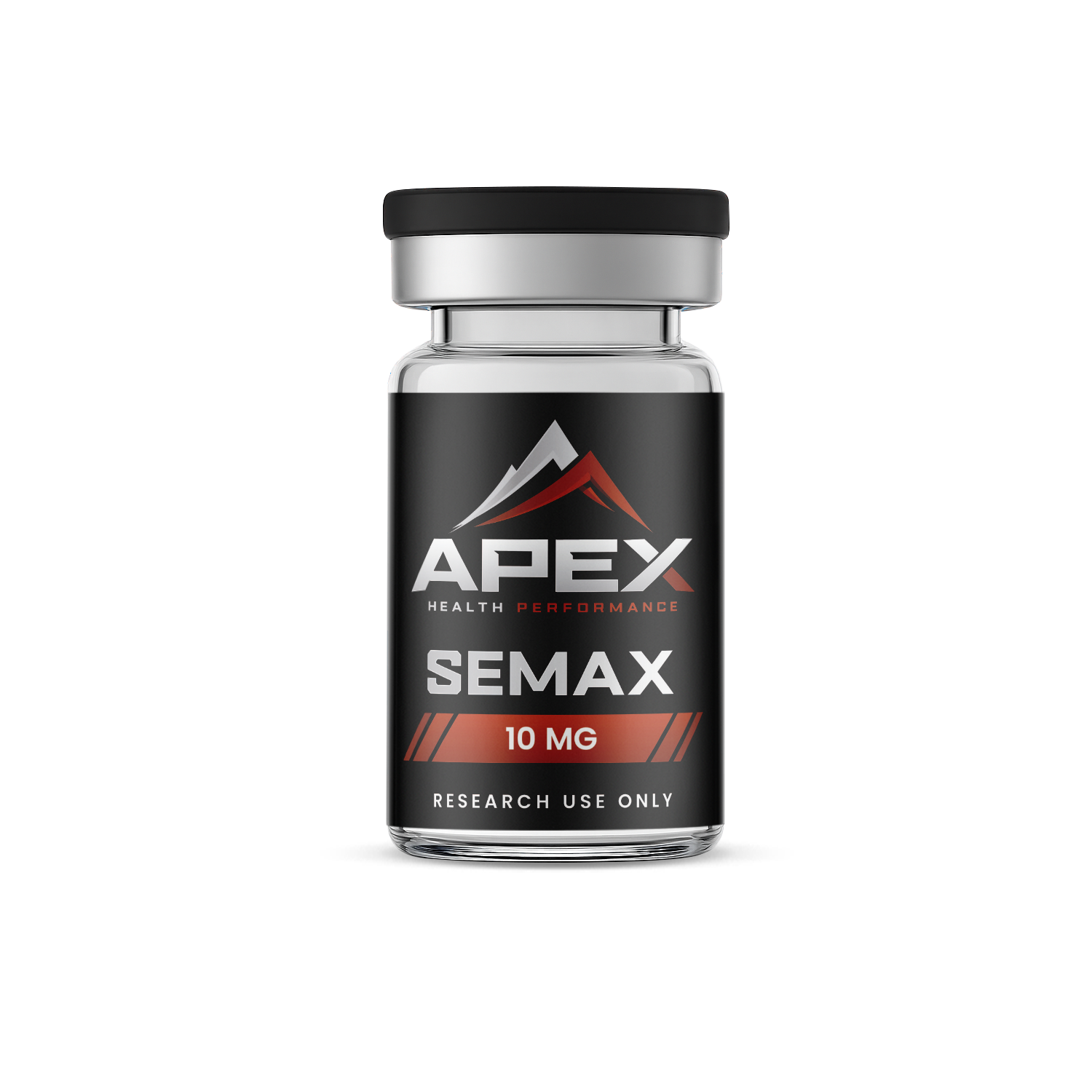
SEMAX (10mg)
$50.00
2 published certificates
Certificate information is temporarily unavailable.
Additional information
| Weight | 0.0625 lbs |
|---|
Published Scientific Research
Explore the full library of peer-reviewed studies, clinical data, mechanism breakdowns, and molecular specifications for SEMAX (10mg).
All research is sourced from PubMed-indexed journals for informational and educational purposes only. For Research Use Only (RUO). Not for human use.
View Full Research Library →Storage Instructions
All products from Apex Health Performance are manufactured using a lyophilization (freeze-drying) process. This method is designed to maintain product integrity and allows vials to remain stable during shipping for approximately 3–4 months.
Once a vial is reconstituted with bacteriostatic water, it should be stored in the refrigerator to help maintain stability. Under these conditions, reconstituted material is generally considered stable for up to 30 days.
Lyophilization is a dehydration technique in which compounds are frozen and then exposed to low pressure. This causes the water in the vial to sublimate directly from solid to gas, leaving behind a stable, crystalline white structure. This powder can be kept at room temperature until reconstitution.
Upon receipt, products should be stored away from heat and light. For short-term use, refrigeration at approximately 4°C (39°F) is suitable. For long-term storage (several months to years), vials may be placed in a freezer at approximately -80°C (-112°F). Freezing is the preferred method for preserving product stability over extended periods.
⚠️ Important Notice:
These products are intended for research use only. Not for human consumption.
Related products
Research Use Only
The following peer-reviewed publications reference compounds for laboratory and in vitro research purposes only. Not for human or animal use. Not intended to diagnose, treat, cure, or prevent any disease or condition.
Published Scientific Research
Peer-reviewed laboratory studies investigating regulatory peptides
Semax peptide targets the μ opioid receptor gene Oprm1 to promote deubiquitination and functional recovery after spinal cord injury in female mice.
Given the key roles of LMP and ubiquitination in SCI pathophysiology, this study investigated how Semax could modulate these pathways to affect functional recovery following SCI. Network pharmacology and docking revealed the μ-opioid receptor as a Semax target.
View Full Study on PubMedSynthetic corticotropins and the GABA-receptor system: Direct and delayed effects.
The molecular mechanism underlying the biological activity of such peptides is partly based on allosteric modulation of various receptors. We analyzed the ability of some biologically active synthetic corticotropins (ACTH(4-7)PGP, ACTH(6-9)PGP, ACTH(7-10)PGP), and glyproline PGPL to affect the GABA-receptor system of rat brain.
View Full Study on PubMedAn integrated approach to study the molecular aspects of regulatory peptides biological mechanism.
An integrated methodological approach to study the molecular aspects of short regulatory neuropeptides biological mechanism is proposed. The complex research is based on radioligand-receptor method of analysis and covers such points of peptides molecular activity as: specific binding of peptides to brain cells plasmatic membranes, formation of tissue specific synacton, influence of peptides (as allosteric modulators) on functionality of different neuroreceptors as well as delayed in time effects of peptides on receptor-binding activity of well-known neuroreceptor systems.
View Full Study on PubMedSemax, an analog of ACTH, regulates expression of immune response genes during ischemic brain injury in rats.
To build the effective strategies for stroke treatment it is necessary to understand the neuroprotective mechanisms that are able to prevent the ischemic injury. However, the molecular mechanisms underlying its neuroprotection and participation of PGP in them are still needed to be clarified.
View Full Study on PubMed[POSSIBLE ROLE OF TRANSTHYRETIN IN THE BIOLOGICAL MECHANISM OF THE REGULATORY PEPTIDE NEUROPROTECTION.].
However, the mechanisms of its action are insufficiently understood and actively studied. High similarity between the effects of Ttr and coupled molecular systems with the Semax effects in ischemic stroke allowed us to suggest that the neuroprotection mechanisms of Semax (and, possibly, of other neuroprotection mechanisms of Semax) could be mediated by Ttr.
View Full Study on PubMedThe peptide semax affects the expression of genes related to the immune and vascular systems in rat brain focal ischemia: genome-wide transcriptional analysis.
BACKGROUND: The nootropic neuroprotective peptide Semax (Met-Glu-His-Phe-Pro-Gly-Pro) has proved efficient in the therapy of brain stroke; however, the molecular mechanisms underlying its action remain obscure. The peptide predominantly enhanced the expression of genes related to the immune system.
View Full Study on PubMedResearch Use Only
The following peer-reviewed publications reference compounds for laboratory and in vitro research purposes only. Not for human or animal use. Not intended to diagnose, treat, cure, or prevent any disease or condition.
Published Scientific Research
Peer-reviewed laboratory studies investigating regulatory peptides
Semax peptide targets the μ opioid receptor gene Oprm1 to promote deubiquitination and functional recovery after spinal cord injury in female mice.
Given the key roles of LMP and ubiquitination in SCI pathophysiology, this study investigated how Semax could modulate these pathways to affect functional recovery following SCI. Network pharmacology and docking revealed the μ-opioid receptor as a Semax target.
View Full Study on PubMedSynthetic corticotropins and the GABA-receptor system: Direct and delayed effects.
The molecular mechanism underlying the biological activity of such peptides is partly based on allosteric modulation of various receptors. We analyzed the ability of some biologically active synthetic corticotropins (ACTH(4-7)PGP, ACTH(6-9)PGP, ACTH(7-10)PGP), and glyproline PGPL to affect the GABA-receptor system of rat brain.
View Full Study on PubMedAn integrated approach to study the molecular aspects of regulatory peptides biological mechanism.
An integrated methodological approach to study the molecular aspects of short regulatory neuropeptides biological mechanism is proposed. The complex research is based on radioligand-receptor method of analysis and covers such points of peptides molecular activity as: specific binding of peptides to brain cells plasmatic membranes, formation of tissue specific synacton, influence of peptides (as allosteric modulators) on functionality of different neuroreceptors as well as delayed in time effects of peptides on receptor-binding activity of well-known neuroreceptor systems.
View Full Study on PubMedSemax, an analog of ACTH, regulates expression of immune response genes during ischemic brain injury in rats.
To build the effective strategies for stroke treatment it is necessary to understand the neuroprotective mechanisms that are able to prevent the ischemic injury. However, the molecular mechanisms underlying its neuroprotection and participation of PGP in them are still needed to be clarified.
View Full Study on PubMed[POSSIBLE ROLE OF TRANSTHYRETIN IN THE BIOLOGICAL MECHANISM OF THE REGULATORY PEPTIDE NEUROPROTECTION.].
However, the mechanisms of its action are insufficiently understood and actively studied. High similarity between the effects of Ttr and coupled molecular systems with the Semax effects in ischemic stroke allowed us to suggest that the neuroprotection mechanisms of Semax (and, possibly, of other neuroprotection mechanisms of Semax) could be mediated by Ttr.
View Full Study on PubMedThe peptide semax affects the expression of genes related to the immune and vascular systems in rat brain focal ischemia: genome-wide transcriptional analysis.
BACKGROUND: The nootropic neuroprotective peptide Semax (Met-Glu-His-Phe-Pro-Gly-Pro) has proved efficient in the therapy of brain stroke; however, the molecular mechanisms underlying its action remain obscure. The peptide predominantly enhanced the expression of genes related to the immune system.
View Full Study on PubMedResearch Use Only
The following peer-reviewed publications reference compounds for laboratory and in vitro research purposes only. Not for human or animal use. Not intended to diagnose, treat, cure, or prevent any disease or condition.
Published Scientific Research
Peer-reviewed laboratory studies investigating regulatory peptides
Semax peptide targets the μ opioid receptor gene Oprm1 to promote deubiquitination and functional recovery after spinal cord injury in female mice.
Given the key roles of LMP and ubiquitination in SCI pathophysiology, this study investigated how Semax could modulate these pathways to affect functional recovery following SCI. Network pharmacology and docking revealed the μ-opioid receptor as a Semax target.
View Full Study on PubMed →Synthetic corticotropins and the GABA-receptor system: Direct and delayed effects.
The molecular mechanism underlying the biological activity of such peptides is partly based on allosteric modulation of various receptors. We analyzed the ability of some biologically active synthetic corticotropins (ACTH(4-7)PGP, ACTH(6-9)PGP, ACTH(7-10)PGP), and glyproline PGPL to affect the GABA-receptor system of rat brain.
View Full Study on PubMed →An integrated approach to study the molecular aspects of regulatory peptides biological mechanism.
An integrated methodological approach to study the molecular aspects of short regulatory neuropeptides biological mechanism is proposed. The complex research is based on radioligand-receptor method of analysis and covers such points of peptides molecular activity as: specific binding of peptides to brain cells plasmatic membranes, formation of tissue specific synacton, influence of peptides (as allosteric modulators) on functionality of different neuroreceptors as well as delayed in time effects of peptides on receptor-binding activity of well-known neuroreceptor systems.
View Full Study on PubMed →Semax, an analog of ACTH, regulates expression of immune response genes during ischemic brain injury in rats.
To build the effective strategies for stroke treatment it is necessary to understand the neuroprotective mechanisms that are able to prevent the ischemic injury. However, the molecular mechanisms underlying its neuroprotection and participation of PGP in them are still needed to be clarified.
View Full Study on PubMed →[POSSIBLE ROLE OF TRANSTHYRETIN IN THE BIOLOGICAL MECHANISM OF THE REGULATORY PEPTIDE NEUROPROTECTION.].
However, the mechanisms of its action are insufficiently understood and actively studied. High similarity between the effects of Ttr and coupled molecular systems with the Semax effects in ischemic stroke allowed us to suggest that the neuroprotection mechanisms of Semax (and, possibly, of other neuroprotection mechanisms of Semax) could be mediated by Ttr.
View Full Study on PubMed →The peptide semax affects the expression of genes related to the immune and vascular systems in rat brain focal ischemia: genome-wide transcriptional analysis.
BACKGROUND: The nootropic neuroprotective peptide Semax (Met-Glu-His-Phe-Pro-Gly-Pro) has proved efficient in the therapy of brain stroke; however, the molecular mechanisms underlying its action remain obscure. The peptide predominantly enhanced the expression of genes related to the immune system.
View Full Study on PubMed →Important Research Notice: These products are research chemicals intended exclusively for in vitro laboratory research by qualified professionals. Not for human or animal consumption. Not approved by the FDA for any therapeutic purpose. Sold strictly for scientific research applications only.