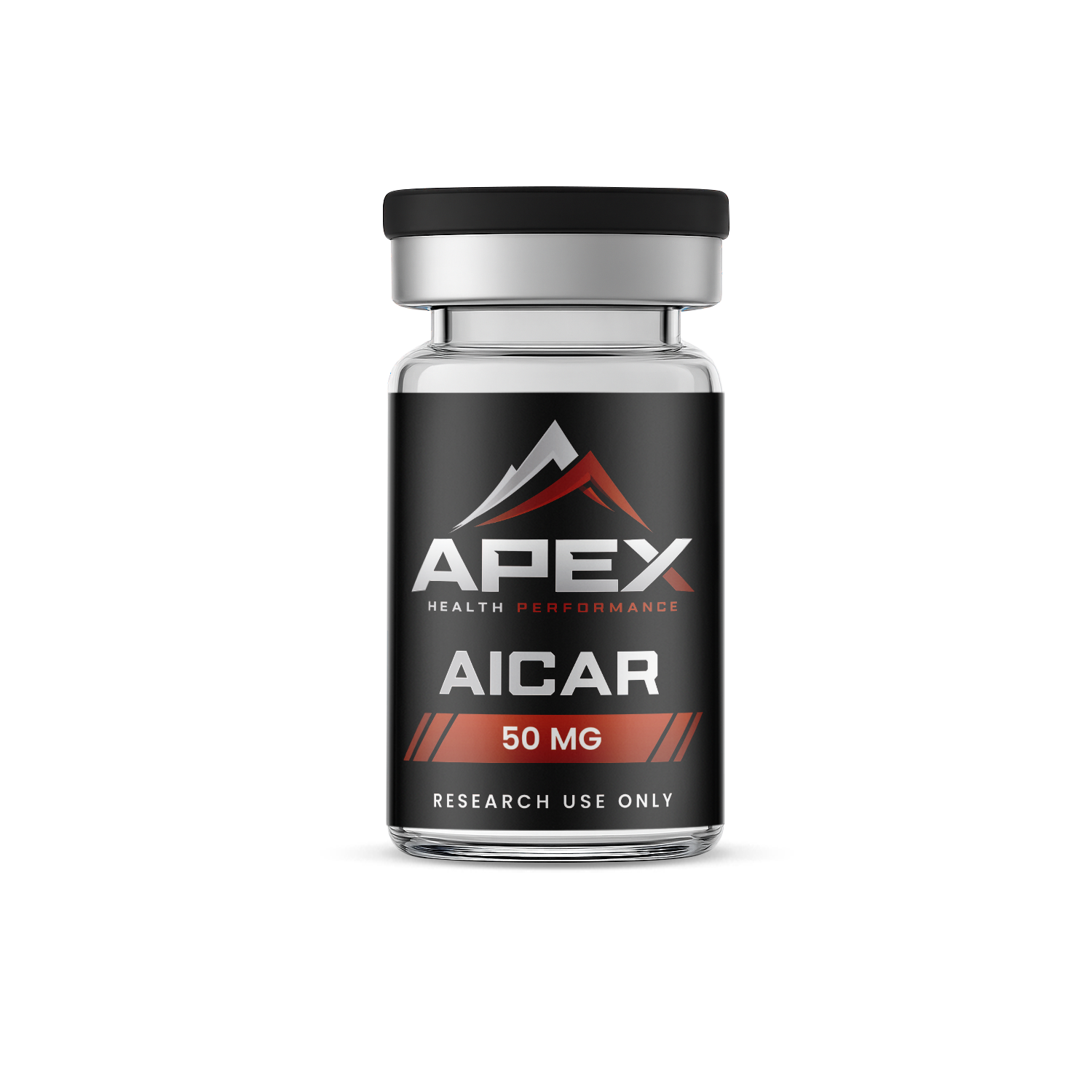
AICAR (50mg)
$130.00
1 published certificate
Certificate information is temporarily unavailable.
Additional information
| Weight | 0.0625 lbs |
|---|
Published Scientific Research
Explore the full library of peer-reviewed studies, clinical data, mechanism breakdowns, and molecular specifications for AICAR (50mg).
All research is sourced from PubMed-indexed journals for informational and educational purposes only. For Research Use Only (RUO). Not for human use.
View Full Research Library →Storage Instructions
All products from Apex Health Performance are manufactured using a lyophilization (freeze-drying) process. This method is designed to maintain product integrity and allows vials to remain stable during shipping for approximately 3–4 months.
Once a vial is reconstituted with bacteriostatic water, it should be stored in the refrigerator to help maintain stability. Under these conditions, reconstituted material is generally considered stable for up to 30 days.
Lyophilization is a dehydration technique in which compounds are frozen and then exposed to low pressure. This causes the water in the vial to sublimate directly from solid to gas, leaving behind a stable, crystalline white structure. This powder can be kept at room temperature until reconstitution.
Upon receipt, products should be stored away from heat and light. For short-term use, refrigeration at approximately 4°C (39°F) is suitable. For long-term storage (several months to years), vials may be placed in a freezer at approximately -80°C (-112°F). Freezing is the preferred method for preserving product stability over extended periods.
⚠️ Important Notice:
These products are intended for research use only. Not for human consumption.
Related products



Research Use Only
The following peer-reviewed publications reference compounds for laboratory and in vitro research purposes only. Not for human or animal use. Not intended to diagnose, treat, cure, or prevent any disease or condition.
Published Scientific Research
Peer-reviewed laboratory studies investigating research peptides
CD137L promotes immune surveillance in melanoma via HLTF regulation.
In summary, our findings elucidate a mechanism controlling CD137L expression and highlight a promising combination therapy to enhance the efficacy of ICBs in melanoma.
View Full Study on PubMedAutophagy in the physiological endometrium and cancer.
Autophagy is a highly conserved catabolic process and a major cellular pathway for the degradation of long-lived proteins and cytoplasmic organelles.
View Full Study on PubMedPRKAA/AMPKα phosphorylation switches the role of RASAL2 from a suppressor to an activator of autophagy.
RASAL2 (RAS protein activator like 2), a RASGTPase activating protein, can catalyze the hydrolysis of RAS-GTP into RAS-GDP to inactivate the RAS pathway in various types of cancer cells. Here we showed that RASAL2 can attenuate PRKAA/AMPKα phosphorylation by recruiting phosphatase PPM1B/pp2cβ, thus inhibiting the initiation of basal autophagy under normal conditions.
View Full Study on PubMedmiR-22-3p regulates muscle fiber-type conversion through inhibiting AMPK/SIRT1/PGC-1α pathway.
Increasing evidence has revealed that skeletal muscle fiber-type conversion is regulated by miRNAs, but the molecular mechanism is still not fully understood. In this study, we confirmed the role of miR-22-3p on skeletal muscle fiber-type conversion and investigated its potential mechanism in C2C12 myotubes.
View Full Study on PubMedNLRP3 inflammasome mediate palmitate-induced endothelial dysfunction.
However, the precise mechanism underlying the role of FFA remains elusive. This study aimed to investigate the role of NLRP3 (NOD-like receptor pyrin domain containing-3) inflammasome in FFA induced endothelial dysfunction.
View Full Study on PubMed[Advances on the anti-inflammatory and protective effect of AMPK activators].
AMP-activated protein kinase (AMPK) is a key enzyme in the regulation of cellular energy homeostasis. Recent studies demonstrated that AMPK also plays an important role in the modulation of inflammation, an energy-intensive molecular response.
View Full Study on PubMedResearch Use Only
The following peer-reviewed publications reference compounds for laboratory and in vitro research purposes only. Not for human or animal use. Not intended to diagnose, treat, cure, or prevent any disease or condition.
Published Scientific Research
Peer-reviewed laboratory studies investigating research peptides
CD137L promotes immune surveillance in melanoma via HLTF regulation.
In summary, our findings elucidate a mechanism controlling CD137L expression and highlight a promising combination therapy to enhance the efficacy of ICBs in melanoma.
View Full Study on PubMedAutophagy in the physiological endometrium and cancer.
Autophagy is a highly conserved catabolic process and a major cellular pathway for the degradation of long-lived proteins and cytoplasmic organelles.
View Full Study on PubMedPRKAA/AMPKα phosphorylation switches the role of RASAL2 from a suppressor to an activator of autophagy.
RASAL2 (RAS protein activator like 2), a RASGTPase activating protein, can catalyze the hydrolysis of RAS-GTP into RAS-GDP to inactivate the RAS pathway in various types of cancer cells. Here we showed that RASAL2 can attenuate PRKAA/AMPKα phosphorylation by recruiting phosphatase PPM1B/pp2cβ, thus inhibiting the initiation of basal autophagy under normal conditions.
View Full Study on PubMedmiR-22-3p regulates muscle fiber-type conversion through inhibiting AMPK/SIRT1/PGC-1α pathway.
Increasing evidence has revealed that skeletal muscle fiber-type conversion is regulated by miRNAs, but the molecular mechanism is still not fully understood. In this study, we confirmed the role of miR-22-3p on skeletal muscle fiber-type conversion and investigated its potential mechanism in C2C12 myotubes.
View Full Study on PubMedNLRP3 inflammasome mediate palmitate-induced endothelial dysfunction.
However, the precise mechanism underlying the role of FFA remains elusive. This study aimed to investigate the role of NLRP3 (NOD-like receptor pyrin domain containing-3) inflammasome in FFA induced endothelial dysfunction.
View Full Study on PubMed[Advances on the anti-inflammatory and protective effect of AMPK activators].
AMP-activated protein kinase (AMPK) is a key enzyme in the regulation of cellular energy homeostasis. Recent studies demonstrated that AMPK also plays an important role in the modulation of inflammation, an energy-intensive molecular response.
View Full Study on PubMedResearch Use Only
The following peer-reviewed publications reference compounds for laboratory and in vitro research purposes only. Not for human or animal use. Not intended to diagnose, treat, cure, or prevent any disease or condition.
Published Scientific Research
Peer-reviewed laboratory studies investigating research peptides
CD137L promotes immune surveillance in melanoma via HLTF regulation.
In summary, our findings elucidate a mechanism controlling CD137L expression and highlight a promising combination therapy to enhance the efficacy of ICBs in melanoma.
View Full Study on PubMed →Autophagy in the physiological endometrium and cancer.
Autophagy is a highly conserved catabolic process and a major cellular pathway for the degradation of long-lived proteins and cytoplasmic organelles.
View Full Study on PubMed →PRKAA/AMPKα phosphorylation switches the role of RASAL2 from a suppressor to an activator of autophagy.
RASAL2 (RAS protein activator like 2), a RASGTPase activating protein, can catalyze the hydrolysis of RAS-GTP into RAS-GDP to inactivate the RAS pathway in various types of cancer cells. Here we showed that RASAL2 can attenuate PRKAA/AMPKα phosphorylation by recruiting phosphatase PPM1B/pp2cβ, thus inhibiting the initiation of basal autophagy under normal conditions.
View Full Study on PubMed →miR-22-3p regulates muscle fiber-type conversion through inhibiting AMPK/SIRT1/PGC-1α pathway.
Increasing evidence has revealed that skeletal muscle fiber-type conversion is regulated by miRNAs, but the molecular mechanism is still not fully understood. In this study, we confirmed the role of miR-22-3p on skeletal muscle fiber-type conversion and investigated its potential mechanism in C2C12 myotubes.
View Full Study on PubMed →NLRP3 inflammasome mediate palmitate-induced endothelial dysfunction.
However, the precise mechanism underlying the role of FFA remains elusive. This study aimed to investigate the role of NLRP3 (NOD-like receptor pyrin domain containing-3) inflammasome in FFA induced endothelial dysfunction.
View Full Study on PubMed →[Advances on the anti-inflammatory and protective effect of AMPK activators].
AMP-activated protein kinase (AMPK) is a key enzyme in the regulation of cellular energy homeostasis. Recent studies demonstrated that AMPK also plays an important role in the modulation of inflammation, an energy-intensive molecular response.
View Full Study on PubMed →Important Research Notice: These products are research chemicals intended exclusively for in vitro laboratory research by qualified professionals. Not for human or animal consumption. Not approved by the FDA for any therapeutic purpose. Sold strictly for scientific research applications only.