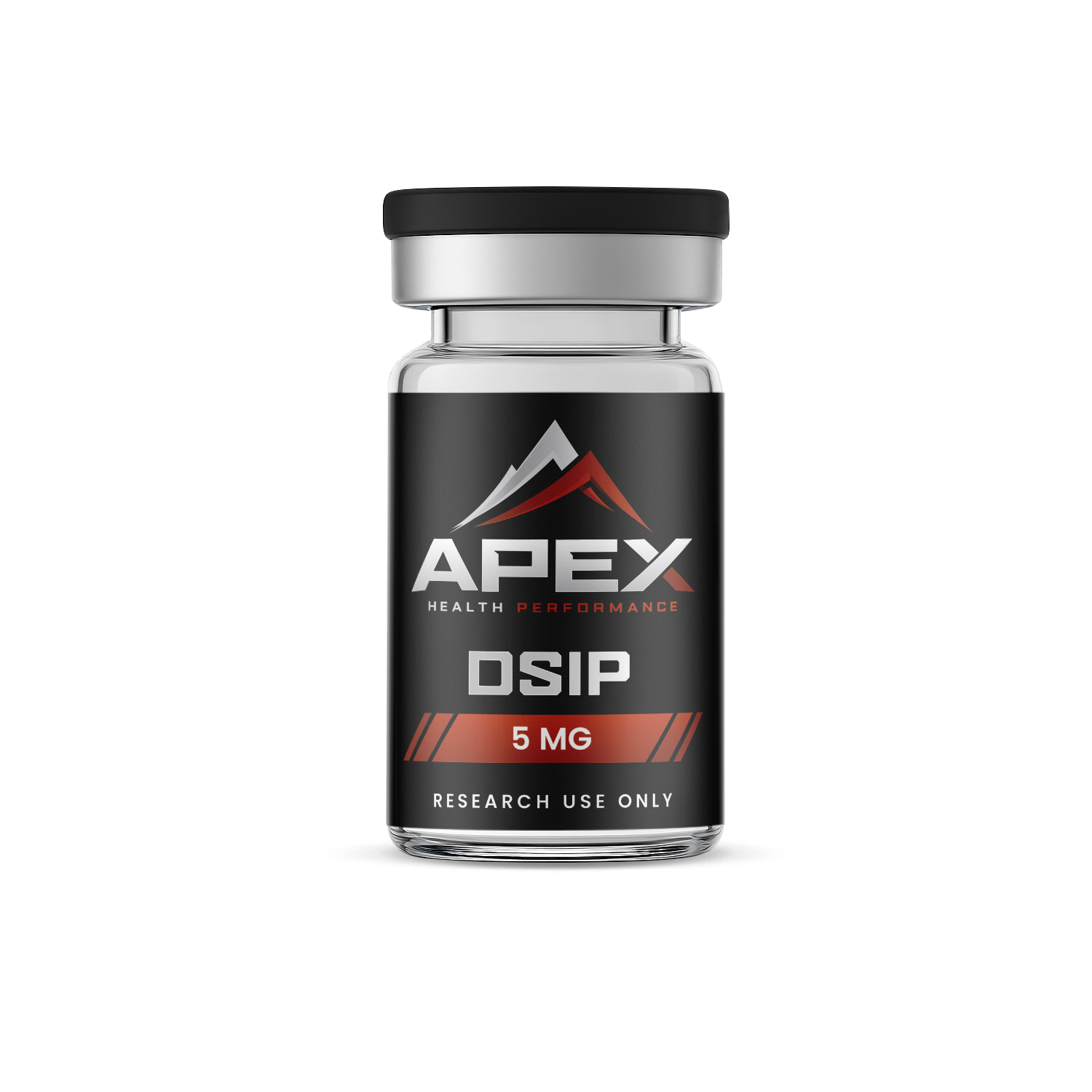
DSIP
$80.00
1 published certificate
Certificate information is temporarily unavailable.
Description
A single-component research material supplied for controlled research environments. Suitable for studies involving peptide characterization and method development in model systems.Not for human use.
Documentation & Quality Assurance
Each lot is sourced through our verified global supply chain with emphasis on traceability and quality control.These documents are reviewed internally and displayed as they become available.
Important Notice
This product is intended for laboratory research use only. It is not intended for human or veterinary use, and must not be used for diagnostic, therapeutic, or clinical purposes.
This material is not a drug, medical device, or dietary supplement, and has not been evaluated by the U.S. Food and Drug Administration.
Quality & Manufacturing
We work directly with the manufacturers. Each supplier is reviewed for reliability, documentation integrity, and transparency in testing.
Our minimum purity standard is 98%. Every batch we ship has its own certificate of analysis, and every certificate confirms identity, purity and net content. Where available, endotoxin testing results are included on Certificates of Analysis to verify laboratory purity; their inclusion is for research quality assessment only and does not imply suitability for human or veterinary use.
All research materials are sealed for integrity and packaged for stability during storage and transport from manufacturing through final delivery.
Additional information
| Weight | 0.0625 lbs |
|---|---|
| Dosage | 5mg, 15mg |
Published Scientific Research
Explore the full library of peer-reviewed studies, clinical data, mechanism breakdowns, and molecular specifications for DSIP.
All research is sourced from PubMed-indexed journals for informational and educational purposes only. For Research Use Only (RUO). Not for human use.
View Full Research Library →Certificate of Analysis
Every batch undergoes independent third-party laboratory analysis to verify identity, potency, and safety. Testing includes quantitative assay verification, heavy metals screening, and comprehensive microbial analysis.
All Available COAs
Storage Instructions
All products from Apex Health Performance are manufactured using a lyophilization (freeze-drying) process. This method is designed to maintain product integrity and allows vials to remain stable during shipping for approximately 3–4 months.
Once a vial is reconstituted with bacteriostatic water, it should be stored in the refrigerator to help maintain stability. Under these conditions, reconstituted material is generally considered stable for up to 30 days.
Lyophilization is a dehydration technique in which compounds are frozen and then exposed to low pressure. This causes the water in the vial to sublimate directly from solid to gas, leaving behind a stable, crystalline white structure. This powder can be kept at room temperature until reconstitution.
Upon receipt, products should be stored away from heat and light. For short-term use, refrigeration at approximately 4°C (39°F) is suitable. For long-term storage (several months to years), vials may be placed in a freezer at approximately -80°C (-112°F). Freezing is the preferred method for preserving product stability over extended periods.
⚠️ Important Notice:
These products are intended for research use only. Not for human consumption.
Related products
-
Wolverine Blend – BPC-157 (5mg) / TB500 (5mg) (Globally Sourced)
Price range: $120.00 through $200.00Select options This product has multiple variants. The options may be chosen on the product page -
-
Research Use Only
The following peer-reviewed publications reference compounds for laboratory and in vitro research purposes only. Not for human or animal use. Not intended to diagnose, treat, cure, or prevent any disease or condition.
Published Scientific Research
Peer-reviewed laboratory studies investigating bioregulatory peptides
secreted peptides crossing the blood-brain barrier and DSIP fusion peptide efficacy in PCPA-induced insomnia mouse models.
This study investigates these properties using a p-chlorophenylalanine (PCPA) -induced insomnia model in mice, an approach akin to traditional methods evaluating sleep-promoting activities in fusion peptides. AIM OF THE STUDY: The research aims to elucidate the sleep-promoting mechanism of DSIP-CBBBP, exploring its impact on neurotransmitter levels and sleep regulation, and to analyze its composition and structure.
View Full Study on PubMed[Antioxidative and detoxifying effects of analogues of delta-sleep inducing peptide (DSIP)].
Antioxidative properties of these peptides were studied in vitro and their detoxifying activity was examined in vivo on a model of toxicosis that was induced by the cisplatin cytostatic, which has been widely used in the cancer treatment. This analogue also demonstrated the most pronounced detoxifying effect towards cisplatin action, resulting in a decrease in the animal death from the acute cisplatin toxicity to 17% (in comparison with 50-67% for the control animals) and restoration of a number of cisplatin-sensitive biochemical blood parameters: decrease in the activity of aspartate aminotransferase and alanine aminotransferase and downregulation of the concentration of the final products of nitrogen exchange (creatinine and urea).
View Full Study on PubMedDelta sleep-inducing peptide (DSIP): a still unresolved riddle.
However, the link between DSIP and sleep has never been further characterized, in part because of the lack of isolation of the DSIP gene, protein and possible related receptor.
View Full Study on PubMedDelta sleep inducing peptide (DSIP): effect on respiration activity in rat brain mitochondria and stress protective potency under experimental hypoxia.
Neuromodulatory delta sleep inducing peptide (DSIP) seems to be implicated in the attenuation of stress-induced pathological metabolic disturbances in various animal species and human beings. It enhanced the respiratory control ratio RCR and the rate of ADP phosphorylation.
View Full Study on PubMed[Neurochemical nature of "congestive" excitation in brain structures during emotional stress].
In the author's opinion, emotional stress-induced congestive excitation is determined by disintegration of molecular chemical properties in the brain regions, by the altered sensitivity of brain neurons to neurotransmitters and neuropeptides.
View Full Study on PubMed[Not Available].
The history of sleep-inducing drugs has followed its own pathways, which were independent from sleep research.
View Full Study on PubMedResearch Use Only
The following peer-reviewed publications reference compounds for laboratory and in vitro research purposes only. Not for human or animal use. Not intended to diagnose, treat, cure, or prevent any disease or condition.
Published Scientific Research
Peer-reviewed laboratory studies investigating bioregulatory peptides
secreted peptides crossing the blood-brain barrier and DSIP fusion peptide efficacy in PCPA-induced insomnia mouse models.
This study investigates these properties using a p-chlorophenylalanine (PCPA) -induced insomnia model in mice, an approach akin to traditional methods evaluating sleep-promoting activities in fusion peptides. AIM OF THE STUDY: The research aims to elucidate the sleep-promoting mechanism of DSIP-CBBBP, exploring its impact on neurotransmitter levels and sleep regulation, and to analyze its composition and structure.
View Full Study on PubMed[Antioxidative and detoxifying effects of analogues of delta-sleep inducing peptide (DSIP)].
Antioxidative properties of these peptides were studied in vitro and their detoxifying activity was examined in vivo on a model of toxicosis that was induced by the cisplatin cytostatic, which has been widely used in the cancer treatment. This analogue also demonstrated the most pronounced detoxifying effect towards cisplatin action, resulting in a decrease in the animal death from the acute cisplatin toxicity to 17% (in comparison with 50-67% for the control animals) and restoration of a number of cisplatin-sensitive biochemical blood parameters: decrease in the activity of aspartate aminotransferase and alanine aminotransferase and downregulation of the concentration of the final products of nitrogen exchange (creatinine and urea).
View Full Study on PubMedDelta sleep-inducing peptide (DSIP): a still unresolved riddle.
However, the link between DSIP and sleep has never been further characterized, in part because of the lack of isolation of the DSIP gene, protein and possible related receptor.
View Full Study on PubMedDelta sleep inducing peptide (DSIP): effect on respiration activity in rat brain mitochondria and stress protective potency under experimental hypoxia.
Neuromodulatory delta sleep inducing peptide (DSIP) seems to be implicated in the attenuation of stress-induced pathological metabolic disturbances in various animal species and human beings. It enhanced the respiratory control ratio RCR and the rate of ADP phosphorylation.
View Full Study on PubMed[Neurochemical nature of "congestive" excitation in brain structures during emotional stress].
In the author's opinion, emotional stress-induced congestive excitation is determined by disintegration of molecular chemical properties in the brain regions, by the altered sensitivity of brain neurons to neurotransmitters and neuropeptides.
View Full Study on PubMed[Not Available].
The history of sleep-inducing drugs has followed its own pathways, which were independent from sleep research.
View Full Study on PubMedResearch Use Only
The following peer-reviewed publications reference compounds for laboratory and in vitro research purposes only. Not for human or animal use. Not intended to diagnose, treat, cure, or prevent any disease or condition.
Published Scientific Research
Peer-reviewed laboratory studies investigating bioregulatory peptides
secreted peptides crossing the blood-brain barrier and DSIP fusion peptide efficacy in PCPA-induced insomnia mouse models.
This study investigates these properties using a p-chlorophenylalanine (PCPA) -induced insomnia model in mice, an approach akin to traditional methods evaluating sleep-promoting activities in fusion peptides. AIM OF THE STUDY: The research aims to elucidate the sleep-promoting mechanism of DSIP-CBBBP, exploring its impact on neurotransmitter levels and sleep regulation, and to analyze its composition and structure.
View Full Study on PubMed →[Antioxidative and detoxifying effects of analogues of delta-sleep inducing peptide (DSIP)].
Antioxidative properties of these peptides were studied in vitro and their detoxifying activity was examined in vivo on a model of toxicosis that was induced by the cisplatin cytostatic, which has been widely used in the cancer treatment. This analogue also demonstrated the most pronounced detoxifying effect towards cisplatin action, resulting in a decrease in the animal death from the acute cisplatin toxicity to 17% (in comparison with 50-67% for the control animals) and restoration of a number of cisplatin-sensitive biochemical blood parameters: decrease in the activity of aspartate aminotransferase and alanine aminotransferase and downregulation of the concentration of the final products of nitrogen exchange (creatinine and urea).
View Full Study on PubMed →Delta sleep-inducing peptide (DSIP): a still unresolved riddle.
However, the link between DSIP and sleep has never been further characterized, in part because of the lack of isolation of the DSIP gene, protein and possible related receptor.
View Full Study on PubMed →Delta sleep inducing peptide (DSIP): effect on respiration activity in rat brain mitochondria and stress protective potency under experimental hypoxia.
Neuromodulatory delta sleep inducing peptide (DSIP) seems to be implicated in the attenuation of stress-induced pathological metabolic disturbances in various animal species and human beings. It enhanced the respiratory control ratio RCR and the rate of ADP phosphorylation.
View Full Study on PubMed →[Neurochemical nature of "congestive" excitation in brain structures during emotional stress].
In the author's opinion, emotional stress-induced congestive excitation is determined by disintegration of molecular chemical properties in the brain regions, by the altered sensitivity of brain neurons to neurotransmitters and neuropeptides.
View Full Study on PubMed →[Not Available].
The history of sleep-inducing drugs has followed its own pathways, which were independent from sleep research.
View Full Study on PubMed →Important Research Notice: These products are research chemicals intended exclusively for in vitro laboratory research by qualified professionals. Not for human or animal consumption. Not approved by the FDA for any therapeutic purpose. Sold strictly for scientific research applications only.