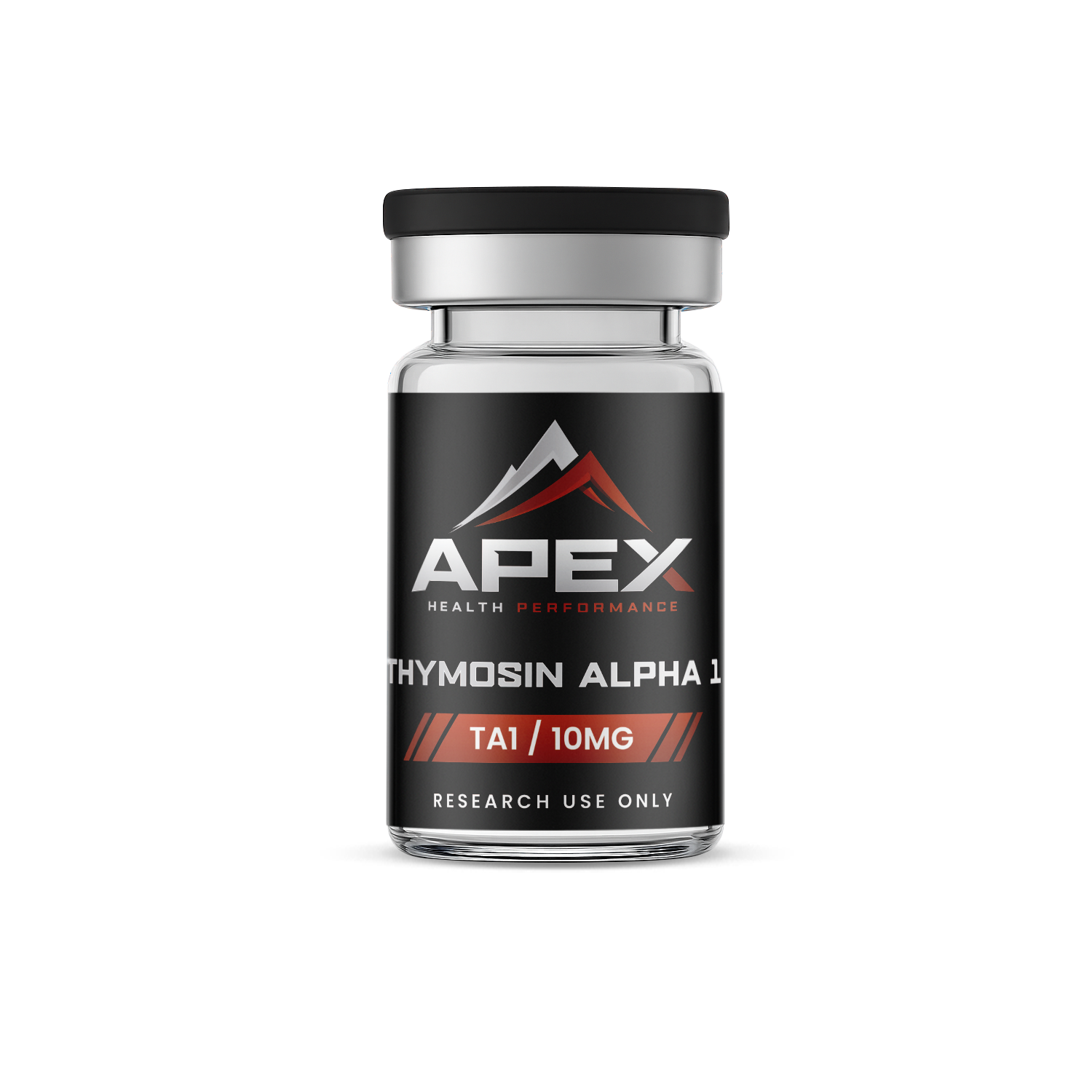
Thymosin Alpha 1 (TA1) (10mg)
$120.00
2 published certificates
Certificate information is temporarily unavailable.
Description
A single-component research material supplied for controlled research environments. Suitable for studies involving peptide characterization and method development in model systems.Not for human use.
Documentation & Quality Assurance
Each lot is sourced through our verified global supply chain with emphasis on traceability and quality control.These documents are reviewed internally and displayed as they become available.
Important Notice
This product is intended for laboratory research use only. It is not intended for human or veterinary use, and must not be used for diagnostic, therapeutic, or clinical purposes.
This material is not a drug, medical device, or dietary supplement, and has not been evaluated by the U.S. Food and Drug Administration.
Quality & Manufacturing
We work directly with the manufacturers. Each supplier is reviewed for reliability, documentation integrity, and transparency in testing.
Our minimum purity standard is 98%. Every batch we ship has its own certificate of analysis, and every certificate confirms identity, purity and net content. Where available, endotoxin testing results are included on Certificates of Analysis to verify laboratory purity; their inclusion is for research quality assessment only and does not imply suitability for human or veterinary use.
All research materials are sealed for integrity and packaged for stability during storage and transport from manufacturing through final delivery.
Additional information
| Weight | 0.0625 lbs |
|---|
Certificate of Analysis
Every batch undergoes independent third-party laboratory analysis to verify identity, potency, and safety. Testing includes quantitative assay verification, heavy metals screening, and comprehensive microbial analysis.
View Certificate of AnalysisStorage Instructions
All products from Apex Health Performance are manufactured using a lyophilization (freeze-drying) process. This method is designed to maintain product integrity and allows vials to remain stable during shipping for approximately 3–4 months.
Once a vial is reconstituted with bacteriostatic water, it should be stored in the refrigerator to help maintain stability. Under these conditions, reconstituted material is generally considered stable for up to 30 days.
Lyophilization is a dehydration technique in which compounds are frozen and then exposed to low pressure. This causes the water in the vial to sublimate directly from solid to gas, leaving behind a stable, crystalline white structure. This powder can be kept at room temperature until reconstitution.
Upon receipt, products should be stored away from heat and light. For short-term use, refrigeration at approximately 4°C (39°F) is suitable. For long-term storage (several months to years), vials may be placed in a freezer at approximately -80°C (-112°F). Freezing is the preferred method for preserving product stability over extended periods.
⚠️ Important Notice:
These products are intended for research use only. Not for human consumption.
Related products
-
NAD+
Price range: $100.00 through $180.00Select options This product has multiple variants. The options may be chosen on the product page -
-
Research Use Only
The following peer-reviewed publications reference compounds for laboratory and in vitro research purposes only. Not for human or animal use. Not intended to diagnose, treat, cure, or prevent any disease or condition.
Published Scientific Research
Peer-reviewed laboratory studies investigating regenerative peptides
Dysfunctional Inflammation in Cystic Fibrosis Airways: From Mechanisms to Novel Therapeutic Approaches.
Cystic fibrosis (CF) is an inherited disorder caused by mutations in the gene encoding for the cystic fibrosis transmembrane conductance regulator (CFTR) protein, an ATP-gated chloride channel expressed on the apical surface of airway epithelial cells. CFTR absence/dysfunction results in defective ion transport and subsequent airway surface liquid dehydration that severely compromise the airway microenvironment. Noxious agents and pathogens are entrapped inside the abnormally thick mucus layer a
View Full Study on PubMedDNA Dendrons as Agents for Intracellular Delivery.
This effect is due to the interaction of the DNA dendrons with scavenger receptor-A on cell surfaces, which results in their rapid endocytosis.
View Full Study on PubMedThymosin α1 protects from CTLA-4 intestinal immunopathology.
Indeed, although beneficial at the tumor site, unlocking a safeguard mechanism of the immune response may trigger autoimmune-like effects at the periphery, thus making the safety of immune checkpoint inhibitors a research priority. Herein, we demonstrate that thymosin α1 (Tα1), an endogenous peptide with immunomodulatory activities, can protect mice from intestinal toxicity in a murine model of immune checkpoint inhibitor-induced colitis.
View Full Study on PubMedDesign and Development of a Novel Peptide for Treating Intestinal Inflammation.
Intestinal inflammatory disorders, such as inflammatory bowel disease (IBD), are associated with increased pro-inflammatory cytokine secretion in the intestines. Likewise, its anti-inflammatory effects and mechanisms were also evaluated using a lipopolysaccharide (LPS)-induced intestinal inflammation murine model.
View Full Study on PubMedThymosin α-1 does not correct F508del-CFTR in cystic fibrosis airway epithelia.
Given the importance of such a drug, we aimed to characterize the underlying molecular mechanisms of action of Tα-1. The studies, which were conducted in 2 independent laboratories with identical outcome, demonstrated that Tα-1 is devoid of activity on mutant CFTR as well as on CaCC.
View Full Study on PubMedThymosin alpha 1 and HIV-1: recent advances and future perspectives.
In spite of the consistent benefits for HIV-1 infected patients undergoing antiretroviral therapy, a complete immune reconstitution is usually not achieved. Actually, antiretroviral therapy may be frequently accompanied by immunological unresponsiveness, persistent inflammatory conditions and inefficient cytotoxic T-cell response. Thymosin alpha 1 is a thymic peptide that demonstrates a peculiar ability to restore immune system homeostasis in different physiological and pathological conditions (
View Full Study on PubMedResearch Use Only
The following peer-reviewed publications reference compounds for laboratory and in vitro research purposes only. Not for human or animal use. Not intended to diagnose, treat, cure, or prevent any disease or condition.
Published Scientific Research
Peer-reviewed laboratory studies investigating regenerative peptides
Aging and Thymosin Alpha-1.
Aging is characterized by immune decline, mainly due to thymic involution-the age-related shrinkage of the thymus gland. This leads to reduced T-cell production, chronic inflammation, and increased susceptibility to age-related diseases. Thymosin alpha-1 (Tα1), a peptide hormone produced by the thymus, exhibits potent immunomodulatory, anti-inflammatory, and antioxidant properties. It helps restore immune function by stimulating T-cell differentiation, enhancing thymic output, and modulating de
View Full Study on PubMedDysfunctional Inflammation in Cystic Fibrosis Airways: From Mechanisms to Novel Therapeutic Approaches.
Cystic fibrosis (CF) is an inherited disorder caused by mutations in the gene encoding for the cystic fibrosis transmembrane conductance regulator (CFTR) protein, an ATP-gated chloride channel expressed on the apical surface of airway epithelial cells. CFTR absence/dysfunction results in defective ion transport and subsequent airway surface liquid dehydration that severely compromise the airway microenvironment. Noxious agents and pathogens are entrapped inside the abnormally thick mucus layer a
View Full Study on PubMedDNA Dendrons as Agents for Intracellular Delivery.
This effect is due to the interaction of the DNA dendrons with scavenger receptor-A on cell surfaces, which results in their rapid endocytosis.
View Full Study on PubMedThymosin α1 protects from CTLA-4 intestinal immunopathology.
Indeed, although beneficial at the tumor site, unlocking a safeguard mechanism of the immune response may trigger autoimmune-like effects at the periphery, thus making the safety of immune checkpoint inhibitors a research priority. Herein, we demonstrate that thymosin α1 (Tα1), an endogenous peptide with immunomodulatory activities, can protect mice from intestinal toxicity in a murine model of immune checkpoint inhibitor-induced colitis.
View Full Study on PubMedDesign and Development of a Novel Peptide for Treating Intestinal Inflammation.
Intestinal inflammatory disorders, such as inflammatory bowel disease (IBD), are associated with increased pro-inflammatory cytokine secretion in the intestines. Likewise, its anti-inflammatory effects and mechanisms were also evaluated using a lipopolysaccharide (LPS)-induced intestinal inflammation murine model.
View Full Study on PubMedThymosin α-1 does not correct F508del-CFTR in cystic fibrosis airway epithelia.
Given the importance of such a drug, we aimed to characterize the underlying molecular mechanisms of action of Tα-1. The studies, which were conducted in 2 independent laboratories with identical outcome, demonstrated that Tα-1 is devoid of activity on mutant CFTR as well as on CaCC.
View Full Study on PubMedResearch Use Only
The following peer-reviewed publications reference compounds for laboratory and in vitro research purposes only. Not for human or animal use. Not intended to diagnose, treat, cure, or prevent any disease or condition.
Published Scientific Research
Peer-reviewed laboratory studies investigating regenerative peptides
Dysfunctional Inflammation in Cystic Fibrosis Airways: From Mechanisms to Novel Therapeutic Approaches.
Cystic fibrosis (CF) is an inherited disorder caused by mutations in the gene encoding for the cystic fibrosis transmembrane conductance regulator (CFTR) protein, an ATP-gated chloride channel expressed on the apical surface of airway epithelial cells. CFTR absence/dysfunction results in defective ion transport and subsequent airway surface liquid dehydration that severely compromise the airway microenvironment. Noxious agents and pathogens are entrapped inside the abnormally thick mucus layer a
View Full Study on PubMed →DNA Dendrons as Agents for Intracellular Delivery.
This effect is due to the interaction of the DNA dendrons with scavenger receptor-A on cell surfaces, which results in their rapid endocytosis.
View Full Study on PubMed →Thymosin α1 protects from CTLA-4 intestinal immunopathology.
Indeed, although beneficial at the tumor site, unlocking a safeguard mechanism of the immune response may trigger autoimmune-like effects at the periphery, thus making the safety of immune checkpoint inhibitors a research priority. Herein, we demonstrate that thymosin α1 (Tα1), an endogenous peptide with immunomodulatory activities, can protect mice from intestinal toxicity in a murine model of immune checkpoint inhibitor-induced colitis.
View Full Study on PubMed →Design and Development of a Novel Peptide for Treating Intestinal Inflammation.
Intestinal inflammatory disorders, such as inflammatory bowel disease (IBD), are associated with increased pro-inflammatory cytokine secretion in the intestines. Likewise, its anti-inflammatory effects and mechanisms were also evaluated using a lipopolysaccharide (LPS)-induced intestinal inflammation murine model.
View Full Study on PubMed →Thymosin α-1 does not correct F508del-CFTR in cystic fibrosis airway epithelia.
Given the importance of such a drug, we aimed to characterize the underlying molecular mechanisms of action of Tα-1. The studies, which were conducted in 2 independent laboratories with identical outcome, demonstrated that Tα-1 is devoid of activity on mutant CFTR as well as on CaCC.
View Full Study on PubMed →Thymosin alpha 1 and HIV-1: recent advances and future perspectives.
In spite of the consistent benefits for HIV-1 infected patients undergoing antiretroviral therapy, a complete immune reconstitution is usually not achieved. Actually, antiretroviral therapy may be frequently accompanied by immunological unresponsiveness, persistent inflammatory conditions and inefficient cytotoxic T-cell response. Thymosin alpha 1 is a thymic peptide that demonstrates a peculiar ability to restore immune system homeostasis in different physiological and pathological conditions (
View Full Study on PubMed →Important Research Notice: These products are research chemicals intended exclusively for in vitro laboratory research by qualified professionals. Not for human or animal consumption. Not approved by the FDA for any therapeutic purpose. Sold strictly for scientific research applications only.