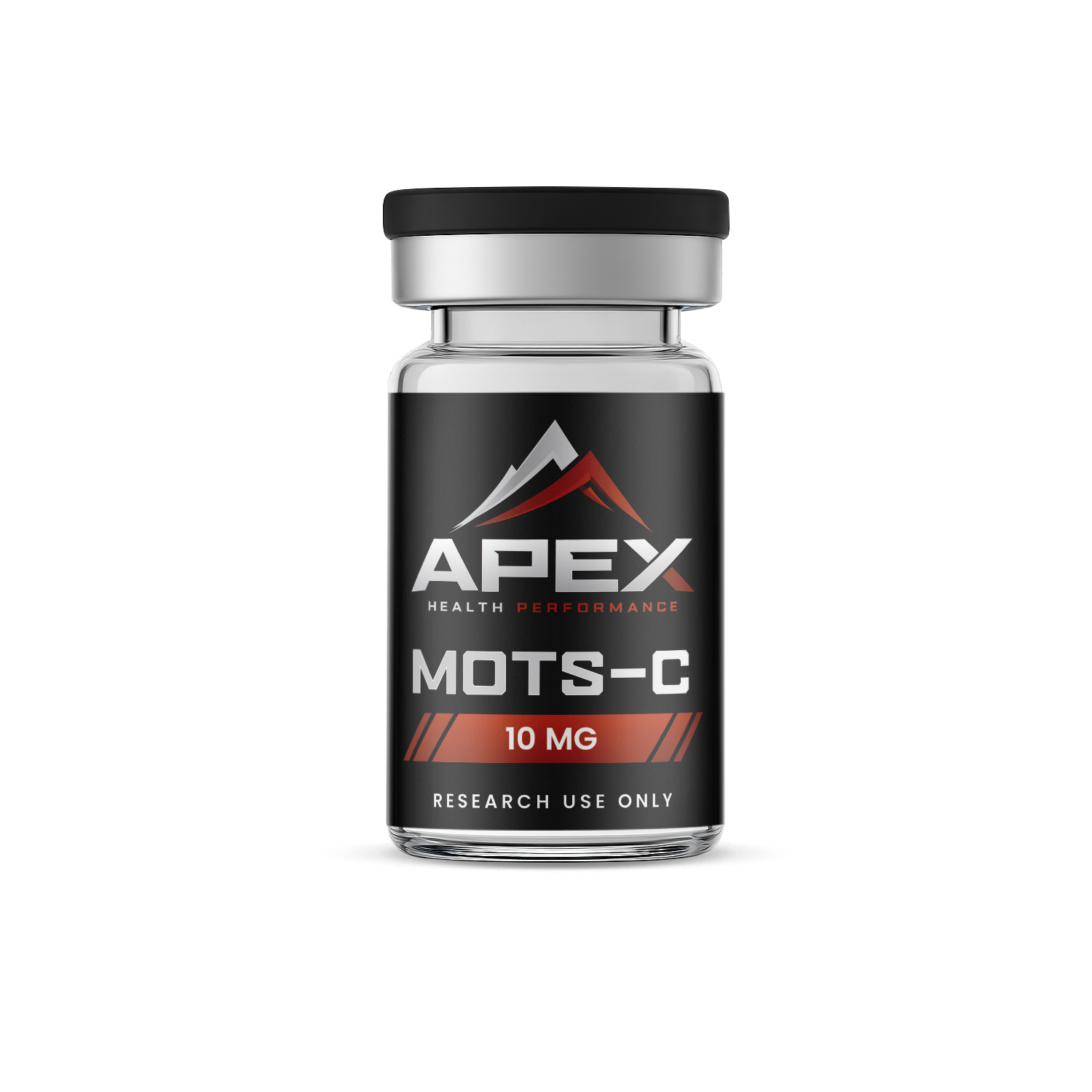
MOTS-c
Price range: $100.00 through $200.00
4 published certificates
Certificate information is temporarily unavailable.
Description
A single-component research material supplied for controlled research environments. Suitable for studies involving mitochondrial-derived peptide characterization and method development in model systems.Not for human use.
Documentation & Quality Assurance
Each lot is sourced through our verified global supply chain with emphasis on traceability and quality control.These documents are reviewed internally and displayed as they become available.
Important Notice
This product is intended for laboratory research use only. It is not intended for human or veterinary use, and must not be used for diagnostic, therapeutic, or clinical purposes.
This material is not a drug, medical device, or dietary supplement, and has not been evaluated by the U.S. Food and Drug Administration.
Quality & Manufacturing
We work directly with the manufacturers. Each supplier is reviewed for reliability, documentation integrity, and transparency in testing.
Our minimum purity standard is 98%. Every batch we ship has its own certificate of analysis, and every certificate confirms identity, purity and net content. Where available, endotoxin testing results are included on Certificates of Analysis to verify laboratory purity; their inclusion is for research quality assessment only and does not imply suitability for human or veterinary use.
All research materials are sealed for integrity and packaged for stability during storage and transport from manufacturing through final delivery.
Additional information
| Weight | 0.0625 lbs |
|---|---|
| Dosage | 10mg, 40mg |
Certificate of Analysis
Every batch undergoes independent third-party laboratory analysis to verify identity, potency, and safety. Testing includes quantitative assay verification, heavy metals screening, and comprehensive microbial analysis.
All Available COAs
Storage Instructions
All products from Apex Health Performance are manufactured using a lyophilization (freeze-drying) process. This method is designed to maintain product integrity and allows vials to remain stable during shipping for approximately 3–4 months.
Once a vial is reconstituted with bacteriostatic water, it should be stored in the refrigerator to help maintain stability. Under these conditions, reconstituted material is generally considered stable for up to 30 days.
Lyophilization is a dehydration technique in which compounds are frozen and then exposed to low pressure. This causes the water in the vial to sublimate directly from solid to gas, leaving behind a stable, crystalline white structure. This powder can be kept at room temperature until reconstitution.
Upon receipt, products should be stored away from heat and light. For short-term use, refrigeration at approximately 4°C (39°F) is suitable. For long-term storage (several months to years), vials may be placed in a freezer at approximately -80°C (-112°F). Freezing is the preferred method for preserving product stability over extended periods.
⚠️ Important Notice:
These products are intended for research use only. Not for human consumption.
Related products
Research Use Only
The following peer-reviewed publications reference compounds for laboratory and in vitro research purposes only. Not for human or animal use. Not intended to diagnose, treat, cure, or prevent any disease or condition.
Published Scientific Research
Peer-reviewed laboratory studies investigating bioregulatory peptides
MOTS-c in type 2 diabetes mellitus: From risk factors to cardiac complications and potential treatment.
Diabetes mellitus is a major global health issue with complex aetiology and a higher risk of consequent health complications. Advances in research and knowledge prompt new therapies to focus beyond glycemic control to include organ-protective therapies better optimise treatment outcomes. MOTS-c, a recently discovered mitochondria-derived peptide, plays a key role in regulating metabolic homeostasis and stress response. Emerging evidence suggests that insufficient MOTS-c production from dysfuncti
View Full Study on PubMedMOTS-c Promotes Glycolysis via AMPK-HIF-1α-PFKFB3 Pathway to Ameliorate Cardiopulmonary Bypass-induced Lung Injury.
We investigated the protective effects of mitochondrial open reading frame of the 12S ribosomal RNA type C (MOTS-c), a mitochondrial-derived peptide, against LIRI-induced acute lung injury (ALI), emphasizing glycolytic reprogramming and ferroptosis in pulmonary microvascular endothelial cells. We hypothesized that MOTS-c exerts its protective effects by regulating glycolysis and suppressing ferroptosis via metabolic signaling pathways.
View Full Study on PubMedMOTS-c modulates pancreatic islet function in rats and pigs in vitro.
This study assessed the expression and secretion of insulin and glucagon, the expression of their receptors, cell viability, and cell death following MOTS-c treatment of the islets.
View Full Study on PubMedDiagnostic relevance of Humanin, GAS5 and miR-21/miR-103 in prostate disease risk stratification.
Results showed significant downregulation of Humanin and GAS5 in both PL and PCa compared to BPH, supporting their role in early disease transition.
View Full Study on PubMedMOTS-c regulates pancreatic alpha and beta cell functions in vitro.
The aim of this study is to determine the influence of the mitochondrial open-reading-frame of the twelve S rRNA-c (MOTS-c) peptide on pancreatic cell physiology. Moreover, in this study, we examined the changes in MOTS-c secretion and expression under different conditions. Our experiments were conducted using laboratory cell line cultures, specifically the INS-1E and αTC-1 cell lines, which represent β and α pancreatic cells, respectively. As the pancreas is an endocrine organ, we also teste
View Full Study on PubMedThe DNA-dependent protein kinase catalytic subunit exacerbates endotoxemia-induced myocardial microvascular injury by disrupting the MOTS-c/JNK pathway and inducing profilin-mediated lamellipodia degradation.
We explored whether endotoxemia-induced myocardial microvascular injury involved DNA-PKcs and MOTS-c dysregulation. Lipopolysaccharide exposure increased DNA-PKcs activity in cardiac microvascular endothelial cells, while pharmacological inhibition or endothelial cell-specific genetic ablation of reduced lipopolysaccharide-induced myocardial microvascular dysfunction.
View Full Study on PubMedResearch Use Only
The following peer-reviewed publications reference compounds for laboratory and in vitro research purposes only. Not for human or animal use. Not intended to diagnose, treat, cure, or prevent any disease or condition.
Published Scientific Research
Peer-reviewed laboratory studies investigating bioregulatory peptides
Diagnostic relevance of Humanin, GAS5 and miR-21/miR-103 in prostate disease risk stratification.
Results showed significant downregulation of Humanin and GAS5 in both PL and PCa compared to BPH, supporting their role in early disease transition.
View Full Study on PubMedMOTS-c regulates pancreatic alpha and beta cell functions in vitro.
The aim of this study is to determine the influence of the mitochondrial open-reading-frame of the twelve S rRNA-c (MOTS-c) peptide on pancreatic cell physiology. Moreover, in this study, we examined the changes in MOTS-c secretion and expression under different conditions. Our experiments were conducted using laboratory cell line cultures, specifically the INS-1E and αTC-1 cell lines, which represent β and α pancreatic cells, respectively. As the pancreas is an endocrine organ, we also teste
View Full Study on PubMedThe DNA-dependent protein kinase catalytic subunit exacerbates endotoxemia-induced myocardial microvascular injury by disrupting the MOTS-c/JNK pathway and inducing profilin-mediated lamellipodia degradation.
We explored whether endotoxemia-induced myocardial microvascular injury involved DNA-PKcs and MOTS-c dysregulation. Lipopolysaccharide exposure increased DNA-PKcs activity in cardiac microvascular endothelial cells, while pharmacological inhibition or endothelial cell-specific genetic ablation of reduced lipopolysaccharide-induced myocardial microvascular dysfunction.
View Full Study on PubMedNovel function of MOTS-c in mitochondrial remodelling contributes to its antiviral role during HBV infection.
This study aims to explore the diagnostic and therapeutic potential of MOTS-c in HBV-related diseases and its molecular mechanism. MOTS-c was found to promote mitochondrial biogenesis and enhance the MAVS (mitochondrial antiviral signalling protein) signalling pathway.
View Full Study on PubMedMOTS-c: A promising mitochondrial-derived peptide for therapeutic exploitation.
To provide additional ideas for future research and development, we tapped into the molecular mechanisms and therapeutic potentials of MOTS-c to improve diseases and combined the technology with synthetic biology in order to offer a new approach to its development and application.
View Full Study on PubMedSerum MOTS-c levels remain unchanged in patients with preeclampsia.
OBJECTIVES: Mitochondrial open-reading-frame of the twelve S rRNA-c (MOTS-c) is a mitochondrial derived peptide which has beneficial effects on muscle metabolism, insulin sensitivity, weight regulation, and bone mineral density. This study aims to investigate whether serum levels of MOTS-c are altered in patients with preeclampsia. MATERIAL AND METHODS: This is cross sectional a case-control study of 30 patients with uncomplicated pregnancy, 30 patients with mild preeclampsia and 30 patients wit
View Full Study on PubMedResearch Use Only
The following peer-reviewed publications reference compounds for laboratory and in vitro research purposes only. Not for human or animal use. Not intended to diagnose, treat, cure, or prevent any disease or condition.
Published Scientific Research
Peer-reviewed laboratory studies investigating bioregulatory peptides
MOTS-c in type 2 diabetes mellitus: From risk factors to cardiac complications and potential treatment.
Diabetes mellitus is a major global health issue with complex aetiology and a higher risk of consequent health complications. Advances in research and knowledge prompt new therapies to focus beyond glycemic control to include organ-protective therapies better optimise treatment outcomes. MOTS-c, a recently discovered mitochondria-derived peptide, plays a key role in regulating metabolic homeostasis and stress response. Emerging evidence suggests that insufficient MOTS-c production from dysfuncti
View Full Study on PubMed →MOTS-c Promotes Glycolysis via AMPK-HIF-1α-PFKFB3 Pathway to Ameliorate Cardiopulmonary Bypass-induced Lung Injury.
We investigated the protective effects of mitochondrial open reading frame of the 12S ribosomal RNA type C (MOTS-c), a mitochondrial-derived peptide, against LIRI-induced acute lung injury (ALI), emphasizing glycolytic reprogramming and ferroptosis in pulmonary microvascular endothelial cells. We hypothesized that MOTS-c exerts its protective effects by regulating glycolysis and suppressing ferroptosis via metabolic signaling pathways.
View Full Study on PubMed →MOTS-c modulates pancreatic islet function in rats and pigs in vitro.
This study assessed the expression and secretion of insulin and glucagon, the expression of their receptors, cell viability, and cell death following MOTS-c treatment of the islets.
View Full Study on PubMed →Diagnostic relevance of Humanin, GAS5 and miR-21/miR-103 in prostate disease risk stratification.
Results showed significant downregulation of Humanin and GAS5 in both PL and PCa compared to BPH, supporting their role in early disease transition.
View Full Study on PubMed →MOTS-c regulates pancreatic alpha and beta cell functions in vitro.
The aim of this study is to determine the influence of the mitochondrial open-reading-frame of the twelve S rRNA-c (MOTS-c) peptide on pancreatic cell physiology. Moreover, in this study, we examined the changes in MOTS-c secretion and expression under different conditions. Our experiments were conducted using laboratory cell line cultures, specifically the INS-1E and αTC-1 cell lines, which represent β and α pancreatic cells, respectively. As the pancreas is an endocrine organ, we also teste
View Full Study on PubMed →The DNA-dependent protein kinase catalytic subunit exacerbates endotoxemia-induced myocardial microvascular injury by disrupting the MOTS-c/JNK pathway and inducing profilin-mediated lamellipodia degradation.
We explored whether endotoxemia-induced myocardial microvascular injury involved DNA-PKcs and MOTS-c dysregulation. Lipopolysaccharide exposure increased DNA-PKcs activity in cardiac microvascular endothelial cells, while pharmacological inhibition or endothelial cell-specific genetic ablation of reduced lipopolysaccharide-induced myocardial microvascular dysfunction.
View Full Study on PubMed →Important Research Notice: These products are research chemicals intended exclusively for in vitro laboratory research by qualified professionals. Not for human or animal consumption. Not approved by the FDA for any therapeutic purpose. Sold strictly for scientific research applications only.