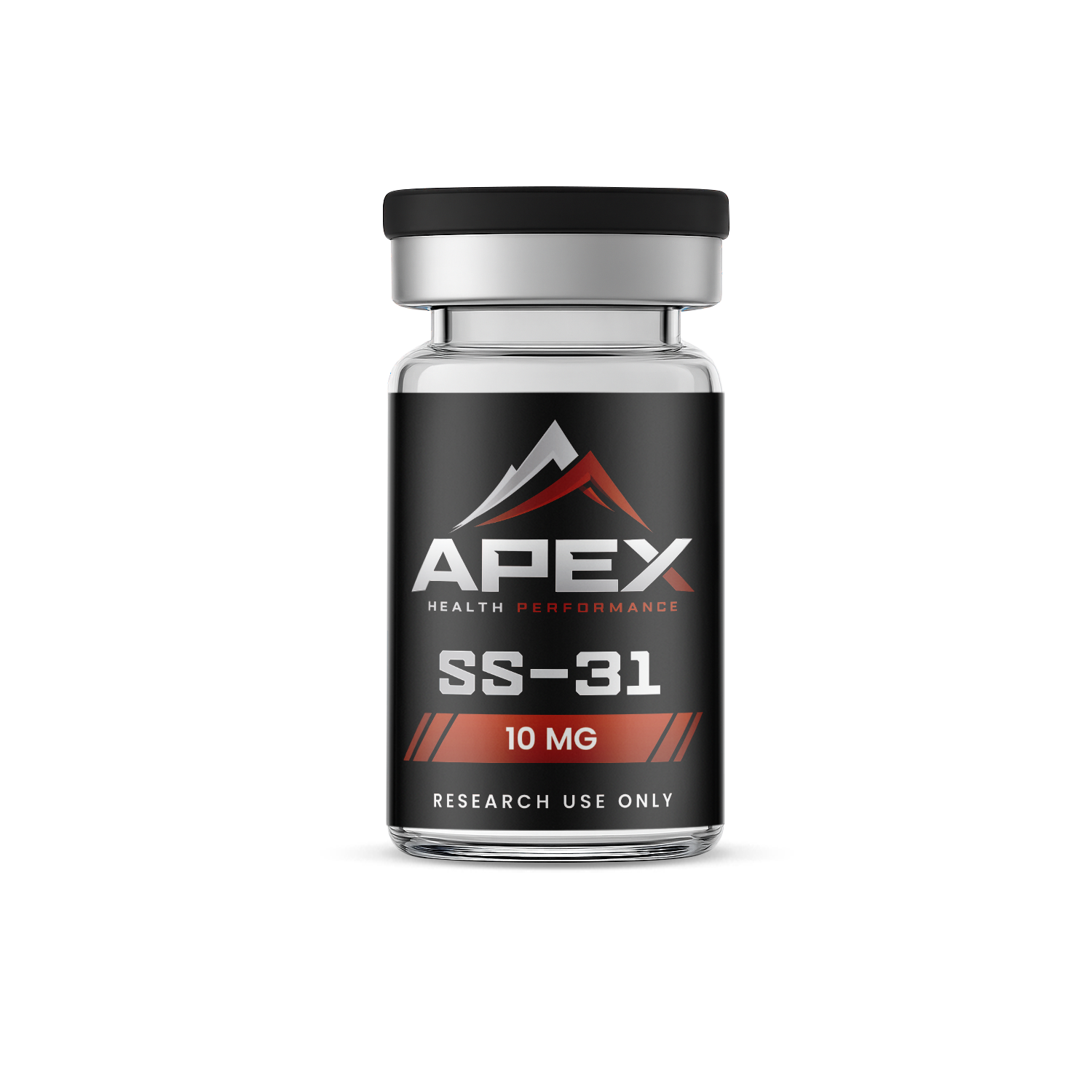
SS-31
Price range: $120.00 through $260.00
2 published certificates
Certificate information is temporarily unavailable.
Description
A single-component research material supplied for controlled research environments. Suitable for studies involving mitochondrial-targeting peptide characterization and method development in model systems.Not for human use.
Documentation & Quality Assurance
Each lot is sourced through our verified global supply chain with emphasis on traceability and quality control.These documents are reviewed internally and displayed as they become available.
Important Notice
This product is intended for laboratory research use only. It is not intended for human or veterinary use, and must not be used for diagnostic, therapeutic, or clinical purposes.
This material is not a drug, medical device, or dietary supplement, and has not been evaluated by the U.S. Food and Drug Administration.
Quality & Manufacturing
We work directly with the manufacturers. Each supplier is reviewed for reliability, documentation integrity, and transparency in testing.
Our minimum purity standard is 98%. Every batch we ship has its own certificate of analysis, and every certificate confirms identity, purity and net content. Where available, endotoxin testing results are included on Certificates of Analysis to verify laboratory purity; their inclusion is for research quality assessment only and does not imply suitability for human or veterinary use.
All research materials are sealed for integrity and packaged for stability during storage and transport from manufacturing through final delivery.
Additional information
| Weight | 0.0625 lbs |
|---|---|
| Dosage | 10mg, 50mg |
Certificate of Analysis
Every batch undergoes independent third-party laboratory analysis to verify identity, potency, and safety. Testing includes quantitative assay verification, heavy metals screening, and comprehensive microbial analysis.
All Available COAs
Storage Instructions
All products from Apex Health Performance are manufactured using a lyophilization (freeze-drying) process. This method is designed to maintain product integrity and allows vials to remain stable during shipping for approximately 3–4 months.
Once a vial is reconstituted with bacteriostatic water, it should be stored in the refrigerator to help maintain stability. Under these conditions, reconstituted material is generally considered stable for up to 30 days.
Lyophilization is a dehydration technique in which compounds are frozen and then exposed to low pressure. This causes the water in the vial to sublimate directly from solid to gas, leaving behind a stable, crystalline white structure. This powder can be kept at room temperature until reconstitution.
Upon receipt, products should be stored away from heat and light. For short-term use, refrigeration at approximately 4°C (39°F) is suitable. For long-term storage (several months to years), vials may be placed in a freezer at approximately -80°C (-112°F). Freezing is the preferred method for preserving product stability over extended periods.
⚠️ Important Notice:
These products are intended for research use only. Not for human consumption.
Related products
Research Use Only
The following peer-reviewed publications reference compounds for laboratory and in vitro research purposes only. Not for human or animal use. Not intended to diagnose, treat, cure, or prevent any disease or condition.
Published Scientific Research
Peer-reviewed laboratory studies investigating metabolic research peptides
Application research of novel peptide mitochondrial-targeted antioxidant SS-31 in mitigating mitochondrial dysfunction.
Due to the pivotal role of mitochondria in the generation of adenosine triphosphate (ATP) and the regulation of cellular homeostasis, mitochondrial dysfunction may exert a profound impact on various physiological systems, potentially precipitating a spectrum of distinct diseases. This article extensively expounds upon the superiority of SS-31 over natural antioxidants and traditional mitochondrial-targeted antioxidants, delves into its mechanisms of modulating mitochondrial function, and comprehensively summarizes its applications in alleviating mitochondrial dysfunction-associated disorders.
View Full Study on PubMedComprehensive dry eye therapy: overcoming ocular surface barrier and combating inflammation, oxidation, and mitochondrial damage.
Currently, anti-inflammatory drugs have shown promising efficacy in treating DED; however, such drugs are associated with side effects. This calls for investigations to overcome these challenges associated with ocular drug administration.
View Full Study on PubMedPharmacologic approaches to prevent skeletal muscle atrophy after spinal cord injury.
The signaling cascades that drive SCI-induced muscle loss are common among most forms of disuse atrophy and include ubiquitin-proteasome signaling and others. However, differing magnitudes and patterns of atrophic signals exist after SCI versus other disuse conditions and are accompanied by endogenous inhibition of IGF-1/PI3K/Akt signaling, which combine to produce exceedingly rapid atrophy.
View Full Study on PubMedMitochondria-Targeted Small Peptide, SS31 Ameliorates Diabetes Induced Mitochondrial Dynamics in Male TallyHO/JngJ Mice.
This study aimed to investigate the possible mitochondrial alterations in the pancreas induced by hyperglycemia in diabetes. The diabetic mice after 24 weeks of age showed overt pancreatic injury as demonstrated by disintegration and atrophy of β cells with vacuolization and reduced islet size.
View Full Study on PubMedPodocyte Aging: Why and How Getting Old Matters.
This review discusses the molecular and cellular mechanisms underlying podocyte aging, how these mechanisms might be augmented by disease in the aged kidney, and approaches to mitigate progressive damage to podocytes. Furthermore, we address how biologic pathways such as those associated with cellular growth confound aging in humans and rodents.
View Full Study on PubMedThe Mitochondria-targeted Peptide, Bendavia, Attenuated Ischemia/Reperfusion-induced Stroke Damage.
We previously reported that bendavia protected human brain microvascular endothelial cells against oxygen/glucose deprivation (OGD)-induced damage via preserving mitochondrial function. The in vitro experiments were conducted utilizing two models: (1) OGD/re-oxygenation (OGD/R) or (2) hydrogen peroxide (HO)-induced neuron damage.
View Full Study on PubMedResearch Use Only
The following peer-reviewed publications reference compounds for laboratory and in vitro research purposes only. Not for human or animal use. Not intended to diagnose, treat, cure, or prevent any disease or condition.
Published Scientific Research
Peer-reviewed laboratory studies investigating metabolic research peptides
Application research of novel peptide mitochondrial-targeted antioxidant SS-31 in mitigating mitochondrial dysfunction.
Due to the pivotal role of mitochondria in the generation of adenosine triphosphate (ATP) and the regulation of cellular homeostasis, mitochondrial dysfunction may exert a profound impact on various physiological systems, potentially precipitating a spectrum of distinct diseases. This article extensively expounds upon the superiority of SS-31 over natural antioxidants and traditional mitochondrial-targeted antioxidants, delves into its mechanisms of modulating mitochondrial function, and comprehensively summarizes its applications in alleviating mitochondrial dysfunction-associated disorders.
View Full Study on PubMedComprehensive dry eye therapy: overcoming ocular surface barrier and combating inflammation, oxidation, and mitochondrial damage.
Currently, anti-inflammatory drugs have shown promising efficacy in treating DED; however, such drugs are associated with side effects. This calls for investigations to overcome these challenges associated with ocular drug administration.
View Full Study on PubMedPharmacologic approaches to prevent skeletal muscle atrophy after spinal cord injury.
The signaling cascades that drive SCI-induced muscle loss are common among most forms of disuse atrophy and include ubiquitin-proteasome signaling and others. However, differing magnitudes and patterns of atrophic signals exist after SCI versus other disuse conditions and are accompanied by endogenous inhibition of IGF-1/PI3K/Akt signaling, which combine to produce exceedingly rapid atrophy.
View Full Study on PubMedMitochondria-Targeted Small Peptide, SS31 Ameliorates Diabetes Induced Mitochondrial Dynamics in Male TallyHO/JngJ Mice.
This study aimed to investigate the possible mitochondrial alterations in the pancreas induced by hyperglycemia in diabetes. The diabetic mice after 24 weeks of age showed overt pancreatic injury as demonstrated by disintegration and atrophy of β cells with vacuolization and reduced islet size.
View Full Study on PubMedPodocyte Aging: Why and How Getting Old Matters.
This review discusses the molecular and cellular mechanisms underlying podocyte aging, how these mechanisms might be augmented by disease in the aged kidney, and approaches to mitigate progressive damage to podocytes. Furthermore, we address how biologic pathways such as those associated with cellular growth confound aging in humans and rodents.
View Full Study on PubMedThe Mitochondria-targeted Peptide, Bendavia, Attenuated Ischemia/Reperfusion-induced Stroke Damage.
We previously reported that bendavia protected human brain microvascular endothelial cells against oxygen/glucose deprivation (OGD)-induced damage via preserving mitochondrial function. The in vitro experiments were conducted utilizing two models: (1) OGD/re-oxygenation (OGD/R) or (2) hydrogen peroxide (HO)-induced neuron damage.
View Full Study on PubMedResearch Use Only
The following peer-reviewed publications reference compounds for laboratory and in vitro research purposes only. Not for human or animal use. Not intended to diagnose, treat, cure, or prevent any disease or condition.
Published Scientific Research
Peer-reviewed laboratory studies investigating metabolic research peptides
Application research of novel peptide mitochondrial-targeted antioxidant SS-31 in mitigating mitochondrial dysfunction.
Due to the pivotal role of mitochondria in the generation of adenosine triphosphate (ATP) and the regulation of cellular homeostasis, mitochondrial dysfunction may exert a profound impact on various physiological systems, potentially precipitating a spectrum of distinct diseases. This article extensively expounds upon the superiority of SS-31 over natural antioxidants and traditional mitochondrial-targeted antioxidants, delves into its mechanisms of modulating mitochondrial function, and comprehensively summarizes its applications in alleviating mitochondrial dysfunction-associated disorders.
View Full Study on PubMed →Comprehensive dry eye therapy: overcoming ocular surface barrier and combating inflammation, oxidation, and mitochondrial damage.
Currently, anti-inflammatory drugs have shown promising efficacy in treating DED; however, such drugs are associated with side effects. This calls for investigations to overcome these challenges associated with ocular drug administration.
View Full Study on PubMed →Pharmacologic approaches to prevent skeletal muscle atrophy after spinal cord injury.
The signaling cascades that drive SCI-induced muscle loss are common among most forms of disuse atrophy and include ubiquitin-proteasome signaling and others. However, differing magnitudes and patterns of atrophic signals exist after SCI versus other disuse conditions and are accompanied by endogenous inhibition of IGF-1/PI3K/Akt signaling, which combine to produce exceedingly rapid atrophy.
View Full Study on PubMed →Mitochondria-Targeted Small Peptide, SS31 Ameliorates Diabetes Induced Mitochondrial Dynamics in Male TallyHO/JngJ Mice.
This study aimed to investigate the possible mitochondrial alterations in the pancreas induced by hyperglycemia in diabetes. The diabetic mice after 24 weeks of age showed overt pancreatic injury as demonstrated by disintegration and atrophy of β cells with vacuolization and reduced islet size.
View Full Study on PubMed →Podocyte Aging: Why and How Getting Old Matters.
This review discusses the molecular and cellular mechanisms underlying podocyte aging, how these mechanisms might be augmented by disease in the aged kidney, and approaches to mitigate progressive damage to podocytes. Furthermore, we address how biologic pathways such as those associated with cellular growth confound aging in humans and rodents.
View Full Study on PubMed →The Mitochondria-targeted Peptide, Bendavia, Attenuated Ischemia/Reperfusion-induced Stroke Damage.
We previously reported that bendavia protected human brain microvascular endothelial cells against oxygen/glucose deprivation (OGD)-induced damage via preserving mitochondrial function. The in vitro experiments were conducted utilizing two models: (1) OGD/re-oxygenation (OGD/R) or (2) hydrogen peroxide (HO)-induced neuron damage.
View Full Study on PubMed →Important Research Notice: These products are research chemicals intended exclusively for in vitro laboratory research by qualified professionals. Not for human or animal consumption. Not approved by the FDA for any therapeutic purpose. Sold strictly for scientific research applications only.