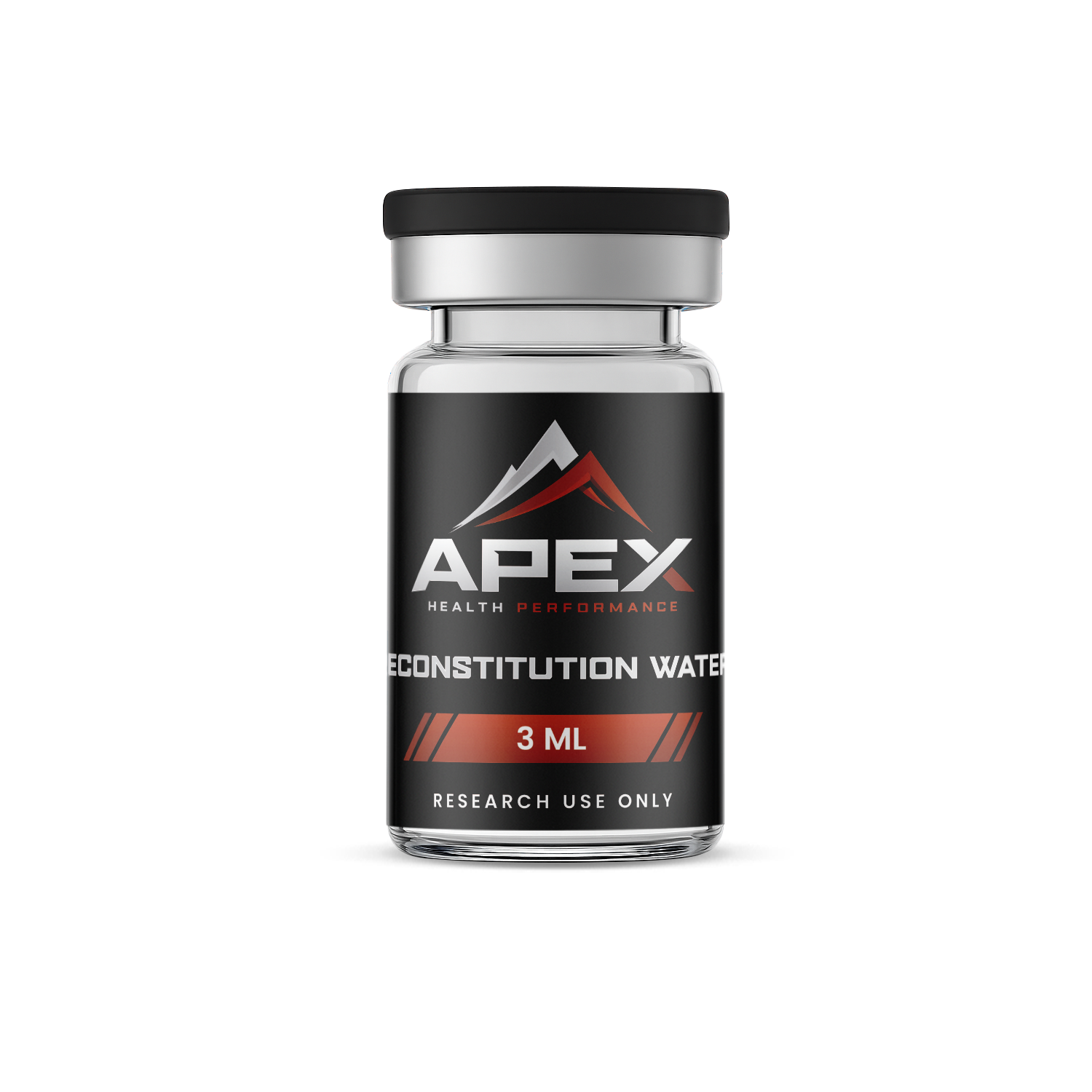
Reconstitution Water
Price range: $10.00 through $15.00
1 published certificate
Certificate information is temporarily unavailable.
Additional information
| Weight | 0.0625 lbs |
|---|---|
| Dosage | 3ml, 10ml |
Storage Instructions
All products from Apex Health Performance are manufactured using a lyophilization (freeze-drying) process. This method is designed to maintain product integrity and allows vials to remain stable during shipping for approximately 3–4 months.
Once a vial is reconstituted with bacteriostatic water, it should be stored in the refrigerator to help maintain stability. Under these conditions, reconstituted material is generally considered stable for up to 30 days.
Lyophilization is a dehydration technique in which compounds are frozen and then exposed to low pressure. This causes the water in the vial to sublimate directly from solid to gas, leaving behind a stable, crystalline white structure. This powder can be kept at room temperature until reconstitution.
Upon receipt, products should be stored away from heat and light. For short-term use, refrigeration at approximately 4°C (39°F) is suitable. For long-term storage (several months to years), vials may be placed in a freezer at approximately -80°C (-112°F). Freezing is the preferred method for preserving product stability over extended periods.
⚠️ Important Notice:
These products are intended for research use only. Not for human consumption.
Related products
Research Use Only
The following peer-reviewed publications reference compounds for laboratory and in vitro research purposes only. Not for human or animal use. Not intended to diagnose, treat, cure, or prevent any disease or condition.
Published Scientific Research
Peer-reviewed laboratory studies investigating research peptides
Long-term potentiation reconstituted with an artificial TARP/PSD-95 complex.
The critical role of AMPA receptor (AMPAR) trafficking in long-term potentiation (LTP) of excitatory synaptic transmission is now well established, but the underlying molecular mechanism is still uncertain. To determine if such interaction is a core minimal component of the AMPAR trafficking and LTP mechanism, we engineered artificial binding partners, which individually were biochemically and functionally dead but which, when expressed together, rescue binding and both basal synaptic transmission and LTP.
View Full Study on PubMedPhase Separation of MAGI2-Mediated Complex Underlies Formation of Slit Diaphragm Complex in Glomerular Filtration Barrier.
Mutations in genes that encode components of this membrane-less compartment have been associated with glomerular diseases. However, the molecular mechanism governing formation of compartmentalized slit diaphragm assembly remains elusive.
View Full Study on PubMedReconstituted Postsynaptic Density as a Molecular Platform for Understanding Synapse Formation and Plasticity.
Proper formation and dynamic responses to stimulations of synapses, both during development and in adult, are fundamental to functions of mammalian brains, although the molecular basis governing formation and modulation of compartmentalized synaptic assemblies is unclear. The reconstituted PSD-like assemblies can cluster receptors, selectively concentrate enzymes, promote actin bundle formation, and expel inhibitory postsynaptic proteins.
View Full Study on PubMedThe Peptidisc, a simple method for stabilizing membrane proteins in detergent-free solution.
Membrane proteins are difficult to work with due to their insolubility in aqueous solution and quite often their poor stability in detergent micelles. Here, we present the peptidisc for their facile capture into water-soluble particles. Unlike the nanodisc, which requires scaffold proteins of different lengths and precise amounts of matching lipids, reconstitution of detergent solubilized proteins in peptidisc only requires a short amphipathic bi-helical peptide (NSP) and no extra lipids. Multip
View Full Study on PubMedTotally synthetic microperoxidase-11.
The synthetic MP-11 showed a considerable magnitude of catalytic activity (27%) against the natural MP-11 in the oxidation of 3,3',5,5'-tetramethylbenzidine by hydrogen peroxide, whereas it showed very low (2.7%) activity of a synthetic variant with a point mutation (VQKCAQC TVE, H8M). Indeed, if hydrogen peroxide existed in the solution phase, the peroxidase-modified electrode showed catalytic current-voltage behaviour regardless of whether it was prepared using natural MP-11 or the synthetic MP-11.
View Full Study on PubMedAlamethicin Supramolecular Organization in Lipid Membranes from F Solid-State NMR.
Alamethicins (ALMs) are antimicrobial peptides of fungal origin. Their sequences are rich in hydrophobic amino acids and strongly interact with lipid membranes, where they cause a well-defined increase in conductivity. Therefore, the peptides are thought to form transmembrane helical bundles in which the more hydrophilic residues line a water-filled pore. Whereas the peptide has been well characterized in terms of secondary structure, membrane topology, and interactions, much fewer data are avai
View Full Study on PubMedResearch Use Only
The following peer-reviewed publications reference compounds for laboratory and in vitro research purposes only. Not for human or animal use. Not intended to diagnose, treat, cure, or prevent any disease or condition.
Published Scientific Research
Peer-reviewed laboratory studies investigating research peptides
Long-term potentiation reconstituted with an artificial TARP/PSD-95 complex.
The critical role of AMPA receptor (AMPAR) trafficking in long-term potentiation (LTP) of excitatory synaptic transmission is now well established, but the underlying molecular mechanism is still uncertain. To determine if such interaction is a core minimal component of the AMPAR trafficking and LTP mechanism, we engineered artificial binding partners, which individually were biochemically and functionally dead but which, when expressed together, rescue binding and both basal synaptic transmission and LTP.
View Full Study on PubMedPhase Separation of MAGI2-Mediated Complex Underlies Formation of Slit Diaphragm Complex in Glomerular Filtration Barrier.
Mutations in genes that encode components of this membrane-less compartment have been associated with glomerular diseases. However, the molecular mechanism governing formation of compartmentalized slit diaphragm assembly remains elusive.
View Full Study on PubMedReconstituted Postsynaptic Density as a Molecular Platform for Understanding Synapse Formation and Plasticity.
Proper formation and dynamic responses to stimulations of synapses, both during development and in adult, are fundamental to functions of mammalian brains, although the molecular basis governing formation and modulation of compartmentalized synaptic assemblies is unclear. The reconstituted PSD-like assemblies can cluster receptors, selectively concentrate enzymes, promote actin bundle formation, and expel inhibitory postsynaptic proteins.
View Full Study on PubMedThe Peptidisc, a simple method for stabilizing membrane proteins in detergent-free solution.
Membrane proteins are difficult to work with due to their insolubility in aqueous solution and quite often their poor stability in detergent micelles. Here, we present the peptidisc for their facile capture into water-soluble particles. Unlike the nanodisc, which requires scaffold proteins of different lengths and precise amounts of matching lipids, reconstitution of detergent solubilized proteins in peptidisc only requires a short amphipathic bi-helical peptide (NSP) and no extra lipids. Multip
View Full Study on PubMedTotally synthetic microperoxidase-11.
The synthetic MP-11 showed a considerable magnitude of catalytic activity (27%) against the natural MP-11 in the oxidation of 3,3',5,5'-tetramethylbenzidine by hydrogen peroxide, whereas it showed very low (2.7%) activity of a synthetic variant with a point mutation (VQKCAQC TVE, H8M). Indeed, if hydrogen peroxide existed in the solution phase, the peroxidase-modified electrode showed catalytic current-voltage behaviour regardless of whether it was prepared using natural MP-11 or the synthetic MP-11.
View Full Study on PubMedAlamethicin Supramolecular Organization in Lipid Membranes from F Solid-State NMR.
Alamethicins (ALMs) are antimicrobial peptides of fungal origin. Their sequences are rich in hydrophobic amino acids and strongly interact with lipid membranes, where they cause a well-defined increase in conductivity. Therefore, the peptides are thought to form transmembrane helical bundles in which the more hydrophilic residues line a water-filled pore. Whereas the peptide has been well characterized in terms of secondary structure, membrane topology, and interactions, much fewer data are avai
View Full Study on PubMedResearch Use Only
The following peer-reviewed publications reference compounds for laboratory and in vitro research purposes only. Not for human or animal use. Not intended to diagnose, treat, cure, or prevent any disease or condition.
Published Scientific Research
Peer-reviewed laboratory studies investigating research peptides
Long-term potentiation reconstituted with an artificial TARP/PSD-95 complex.
The critical role of AMPA receptor (AMPAR) trafficking in long-term potentiation (LTP) of excitatory synaptic transmission is now well established, but the underlying molecular mechanism is still uncertain. To determine if such interaction is a core minimal component of the AMPAR trafficking and LTP mechanism, we engineered artificial binding partners, which individually were biochemically and functionally dead but which, when expressed together, rescue binding and both basal synaptic transmission and LTP.
View Full Study on PubMed →Phase Separation of MAGI2-Mediated Complex Underlies Formation of Slit Diaphragm Complex in Glomerular Filtration Barrier.
Mutations in genes that encode components of this membrane-less compartment have been associated with glomerular diseases. However, the molecular mechanism governing formation of compartmentalized slit diaphragm assembly remains elusive.
View Full Study on PubMed →Reconstituted Postsynaptic Density as a Molecular Platform for Understanding Synapse Formation and Plasticity.
Proper formation and dynamic responses to stimulations of synapses, both during development and in adult, are fundamental to functions of mammalian brains, although the molecular basis governing formation and modulation of compartmentalized synaptic assemblies is unclear. The reconstituted PSD-like assemblies can cluster receptors, selectively concentrate enzymes, promote actin bundle formation, and expel inhibitory postsynaptic proteins.
View Full Study on PubMed →The Peptidisc, a simple method for stabilizing membrane proteins in detergent-free solution.
Membrane proteins are difficult to work with due to their insolubility in aqueous solution and quite often their poor stability in detergent micelles. Here, we present the peptidisc for their facile capture into water-soluble particles. Unlike the nanodisc, which requires scaffold proteins of different lengths and precise amounts of matching lipids, reconstitution of detergent solubilized proteins in peptidisc only requires a short amphipathic bi-helical peptide (NSP) and no extra lipids. Multip
View Full Study on PubMed →Totally synthetic microperoxidase-11.
The synthetic MP-11 showed a considerable magnitude of catalytic activity (27%) against the natural MP-11 in the oxidation of 3,3',5,5'-tetramethylbenzidine by hydrogen peroxide, whereas it showed very low (2.7%) activity of a synthetic variant with a point mutation (VQKCAQC TVE, H8M). Indeed, if hydrogen peroxide existed in the solution phase, the peroxidase-modified electrode showed catalytic current-voltage behaviour regardless of whether it was prepared using natural MP-11 or the synthetic MP-11.
View Full Study on PubMed →Alamethicin Supramolecular Organization in Lipid Membranes from F Solid-State NMR.
Alamethicins (ALMs) are antimicrobial peptides of fungal origin. Their sequences are rich in hydrophobic amino acids and strongly interact with lipid membranes, where they cause a well-defined increase in conductivity. Therefore, the peptides are thought to form transmembrane helical bundles in which the more hydrophilic residues line a water-filled pore. Whereas the peptide has been well characterized in terms of secondary structure, membrane topology, and interactions, much fewer data are avai
View Full Study on PubMed →Important Research Notice: These products are research chemicals intended exclusively for in vitro laboratory research by qualified professionals. Not for human or animal consumption. Not approved by the FDA for any therapeutic purpose. Sold strictly for scientific research applications only.